
Brake Warning Signs, Ranked by How Urgent They Are
Brakes rarely fail without warning. They warn you in a specific order, and the difference between a squeal and a grind is the difference between next week and right now.
Grinding, a pedal that sinks towards the floor, and a red brake warning light all mean stop driving today — those are worn-through pads, lost hydraulic pressure or a leak. Squeal is the wear indicator telling you to book pads within a week or two. Judder through the pedal, a pull to one side, or longer stopping distances are real faults worth fixing soon, but they are not usually same-day emergencies unless they are getting worse fast.
Every part of a braking system wears in a predictable way, and each stage announces itself differently. Friction material gets thinner. Fluid absorbs moisture and loses boiling point. Caliper sliders seize with dust and corrosion. Discs pick up uneven deposits. None of that happens overnight, which means a driver who knows what each noise and pedal feel actually indicates has weeks of warning before anything becomes dangerous.
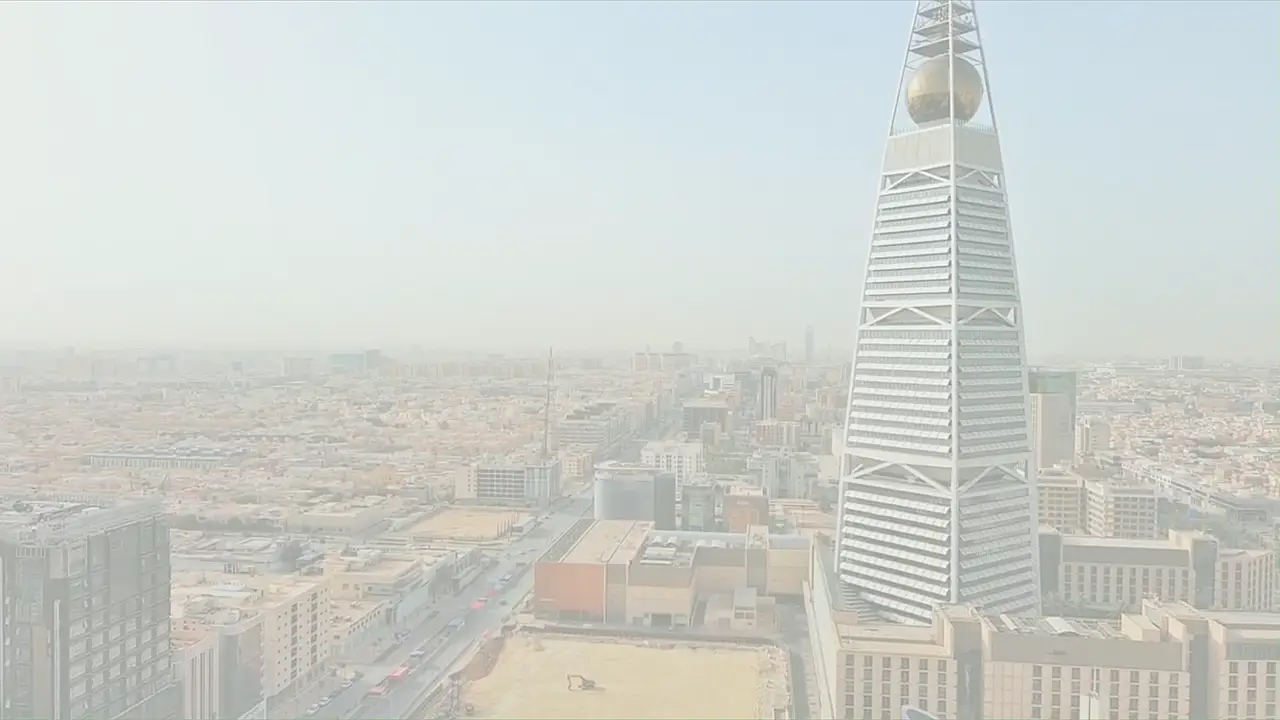
Riyadh conditions compress that timeline. Braking is heat management, and a car that has been sitting on open tarmac at 48°C starts every stop with less thermal headroom than it would in a mild climate. Stop-start traffic on the Eastern Ring Road never gives the pads a cooling run between applications. The long spiral descents into tower basement car parks have drivers riding the pedal the whole way down. Fine sand acts as grinding paste on the disc face. Pads and fluid here work far closer to their limits than the service interval assumes.
Squeal: the wear indicator doing its job
Most pads carry a small steel tab set at a depth of roughly two to three millimetres of remaining friction material. When the pad wears down to it, the tab touches the disc and makes a high-pitched squeal that comes and goes as the disc surface changes temperature. It is not a failure — it is the part working exactly as designed, and it is the cheapest warning you will get. Book pads within a week or two and the discs are usually saved.
Not every squeak is a wear indicator, though. A light squeal on the first two or three stops of a cold January morning, which then disappears completely, is usually surface rust flashing off the discs overnight. Some hard, high-metal-content pad compounds also squeal on a light car when the anti-rattle shims are missing or the slider pins were fitted dry. The distinction is simple: a wear indicator squeals with the brakes applied and gets steadily more frequent week by week. Morning rust squeal disappears and stays gone.
- Squeal on braking that gets more frequent each week — wear indicator, book pads soon
- Two or three squeaks on a cold morning that then vanish — surface rust, normal
- Squeal only in reverse — usually pad taper or a dry slider, worth checking at the next service
- New pads that squeal from day one — missing shims, dry pins or a skipped bedding-in
Grinding: stop driving today
A deep metallic grinding or scraping you can hear with the windows up means the friction material is gone and the steel backing plate is now cutting into the disc. The car will still slow down, but with a fraction of the friction it should have and a disc surface that is being destroyed every time you touch the pedal. On a busy road this is the sound of a stopping distance you cannot predict, and it is the one symptom where continuing to drive is genuinely not an option.
It is also expensive to ignore. A pad change caught at the squeal stage is a straightforward job. Left until it grinds, you are almost always replacing discs as well, and if the backing plate has cut deep enough it can catch and damage the caliper. Worse, once the pad is metal-to-metal it can overheat the caliper piston and boil the fluid in that corner, which brings a soft pedal into the picture too. Park the car, take the wheel off if you can, and look.
Judder through the pedal or steering wheel
A pulsing that you feel through the pedal and often through the steering wheel as you slow from ring road speed is thickness variation across the disc face. Almost everyone calls it a warped disc, and almost every time it is not. What normally happens is uneven transfer of pad material onto the disc — a glazed or overheated pad deposits friction material in patches, the disc effectively becomes thicker in some places than others, and the caliper pushes back at you once per wheel revolution.
It is a real fault, but it is a comfort and wear problem before it is a safety problem, so treat it as fix-it-soon rather than stop-now. Judder felt mainly through the steering wheel points to the front discs; judder felt mainly through the pedal or the seat points to the rear. It is diagnosed with a micrometer at several points around the disc and a dial gauge for runout, not by guessing. Sometimes fresh pads properly bedded in cure it; sometimes the discs are finished.
A soft or sinking pedal: stop, this is hydraulic
The pedal should feel firm and stop at a consistent height. If it feels spongy, travels much further than it used to, or slowly sinks towards the floor while you hold steady pressure at a red light, the hydraulic system has a problem. Spongy usually means air or moisture-laden fluid that has boiled — brake fluid absorbs water from the air, water lowers the boiling point, and after a long descent into a basement car park in July that mixture can boil and put compressible vapour into the lines.
A pedal that sinks slowly under constant pressure is different and worse. That usually means the master cylinder seals are bypassing internally, or fluid is escaping from a leaking flexible hose, hard line or caliper seal. Either way, pressure is not being held, and the failure is progressive. Check the reservoir level and look for wet patches on the inside of the wheels or a damp spot on the driveway. This symptom means stop driving, not drive carefully — the pedal that is soft today can go to the floor tomorrow.
- Pedal travels noticeably further than it did a month ago
- Pedal slowly sinks towards the floor while you hold it at a light
- Fluid level in the reservoir has dropped with no pad wear to explain it
- A wet, oily film on the inside face of a wheel or on the inner tyre sidewall
- Pedal firm on the first press but soft on the second, or the reverse
- Brake fluid that has gone dark brown instead of clear straw colour
Pulling to one side, a hot wheel, and longer stopping distances
If the car steers itself towards one side under braking, one corner is doing more work than the other. The usual cause is a sticking caliper — the slider pins seize with dust and corrosion, or the piston stops retracting, so one pad drags or one side barely applies. A flexible brake hose that has broken down internally can also act like a one-way valve, holding pressure at that caliper after you lift off. Feel the wheels carefully after a drive: one noticeably hotter than the rest confirms a dragging brake.
Longer stopping distances without any noise are easy to miss because they arrive gradually. Causes include glazed pads that have overheated and hardened, cheap friction material working past its designed temperature, contaminated pads from a leaking caliper, and old fluid. In Riyadh the glazing case is common: a bargain pad compound formulated for a mild climate loses its bite in this heat, and the driver simply adapts by pressing harder without registering that anything changed. If you are braking earlier than you used to, have it measured.
What the dash lights actually mean
A red brake warning light is the serious one. Depending on the car it means the park brake is engaged, the fluid level in the reservoir has dropped below minimum, or a pressure differential has been detected between the two hydraulic circuits. Release the park brake fully; if the light stays on, treat it as a fluid or hydraulic fault and stop. A dual-circuit system is designed so half the braking survives a leak, but you should not be driving on the half that is left.
An amber ABS light is less urgent but not nothing. Normal braking still works; the anti-lock function is switched off. That matters most in a hard emergency stop on a dusty or wet surface, where a locked front wheel takes away your ability to steer around the problem. The usual causes are a dirty or failed wheel speed sensor, a chafed sensor wire or a corroded reluctor ring, and all of them are read with a scan tool and live wheel-speed data rather than guessed at.
- Red brake light on with the park brake released — stop, check fluid, do not keep driving
- Amber ABS light — brakes work, anti-lock does not; get it scanned this week
- Both red and ABS lights together — often a hydraulic or sensor fault affecting stability control too
- Brake pad wear light on cars with electronic sensors — pads are at minimum, book them
- ABS activating on a normal dry stop — a faulty sensor or reluctor ring, not clever braking
- Any brake warning that appears alongside a change in pedal feel — treat as urgent
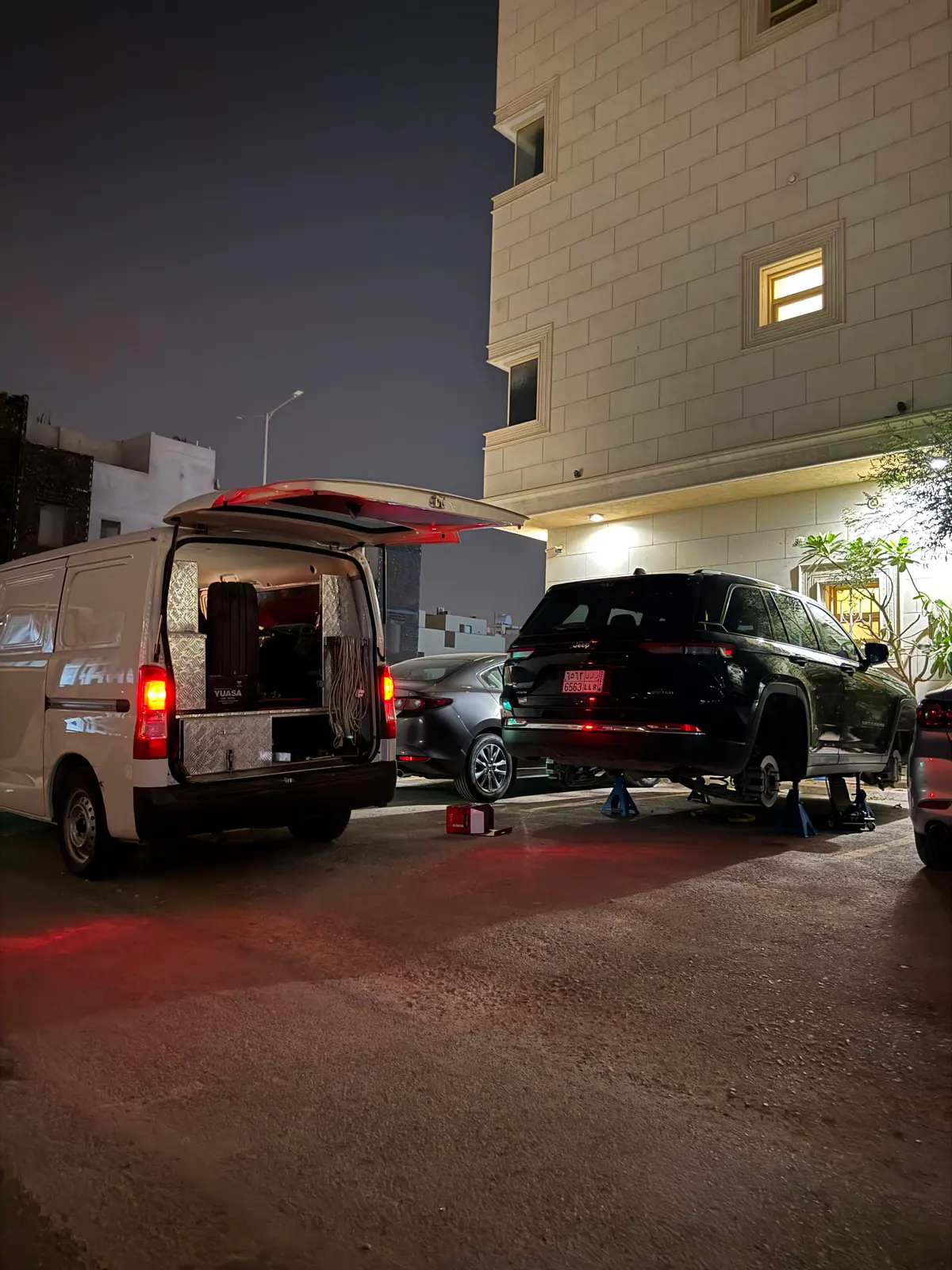
If your brakes are grinding, the pedal is sinking, or a red brake light is on, do not drive to a workshop to have it looked at. That is the drive where the fault finishes what it started. Call and stay where you are — a villa driveway, a compound parking bay, an office tower basement level or the shoulder of the ring road all work. A technician reaches most Riyadh addresses in around 10 minutes, 24 hours a day, including nights, Fridays, Ramadan and Eid.
The visit starts with measurement rather than an opinion. Wheels off, pad thickness recorded front and rear, disc thickness and runout measured against the manufacturer minimums, fluid moisture tested, caliper pistons and slider pins checked for free movement, and hoses and lines inspected. You see those numbers next to the limits before anything is quoted, and pads with real life left in them stay on the car. Pads, discs, fluid changes, caliper cleaning and handbrake adjustment are all done on site, and when a job genuinely needs a workshop we say so and put the car on a flatbed. Call or WhatsApp 057 970 1115 — the price is agreed before we start.
More guides for Riyadh drivers
Breaking Down on the Riyadh Ring Road
The safe order of actions on the Northern or Eastern Ring Road, and exactly what to say when you call.
Read guide ServicingCar Maintenance Schedule for Saudi Roads
What to service every 5k, 10k, 20k, 40k and 60k km in Saudi heat and dust, and what fails first here.
Read guide Buying & adviceMobile Car Repair vs a Workshop
What gets finished at your kerb, what genuinely needs a lift, and how to tell the two apart quickly.
Read guideQuestions drivers ask
Three of them. Metallic grinding, because the friction material is gone and the disc is being cut. A pedal that sinks towards the floor under steady pressure, because the hydraulic system is not holding pressure. And a red brake warning light with the park brake released, because it usually means low fluid or a pressure fault between circuits. Everything else — squeal, judder, a mild pull — needs attention soon but is not a stop-now emergency.
The wear indicator is set at roughly two to three millimetres of remaining material, which is normally a few hundred to a couple of thousand kilometres of ordinary driving. In Riyadh stop-start traffic it goes faster than that. Treat it as a week or two, not a month. The reason to act quickly is money as much as safety: pads caught at the squeal stage usually save the discs, and pads left until they grind rarely do.
Usually not warped in the literal sense. The common cause is uneven pad material transferred onto the disc face, which creates thickness variation and a pulse once per wheel revolution. It is measured with a micrometer at several points around the disc and a dial gauge for runout. That measurement decides whether new pads bedded in correctly will cure it or whether the discs are past their minimum thickness and need replacing.
More often than the interval printed for a mild European market. Brake fluid is hygroscopic — it pulls moisture out of the air — and water lowers its boiling point, which is precisely what you do not want on a long basement car park descent in July. Rather than guess, moisture content is tested on site with a meter. If it reads high or the fluid has gone dark brown, it is a flush; if it tests fine, it is left alone.
The normal brakes still work, so it is not a stop-immediately fault, but the anti-lock function is off. In a hard stop on a dusty or wet road a wheel can lock and you lose the ability to steer around what you are braking for. Most ABS lights are a dirty or failed wheel speed sensor, a damaged sensor wire or a corroded reluctor ring, all of which are diagnosed on site with a scan tool and live data.
Usually because a step was skipped at fitting. Slider pins that were not cleaned and greased, missing anti-rattle shims or clips, a hub face that was not cleaned so the disc does not sit flat, or pads that were never bedded in on a controlled series of stops. Sometimes it is simply a hard, high-metal compound on a light car. The wheel needs to come off to find the actual cause rather than waiting for it to wear off.

Rather we just handled it?
Call +966 57 970 1115 and a mobile technician comes to your car anywhere in Riyadh — 24/7, price agreed first.