
A Realistic Car Maintenance Schedule for Saudi Arabia
The schedule in the manual was written for a milder country. Here is the same schedule adjusted for 48°C summers, constant dust and long idles in Riyadh traffic.
In Saudi conditions, work to shorter intervals than the manual's headline figures: oil and oil filter around every 5,000 to 10,000 km depending on the oil, air and cabin filters every 10,000 km or sooner, brake fluid and coolant checked yearly, spark plugs and transmission fluid in the 40,000 to 60,000 km window, and a battery load test every summer. Season matters as much as mileage — cooling, AC and battery checks belong in spring, before the heat arrives.
A maintenance schedule is a list of parts that wear out, ordered by how fast they wear. Change the climate and the order changes with it. In Saudi Arabia the heat attacks anything rubber, anything electrical and anything holding fluid, while airborne sand attacks anything that filters or slides. That is why the failures a workshop here sees most often — batteries, AC compressors, radiator hoses, wiper blades, suspension bushes, brake fluid full of moisture — are not the same list a workshop in a cool climate sees.
The schedule below is arranged by odometer reading because that is how people think, but the honest version has two axes. Distance drives mechanical wear. Time and temperature drive chemical ageing, and in this climate that second axis is often the one that gets you. A car doing 6,000 km a year inside Riyadh still needs its brake fluid, coolant and battery looked at on a calendar, not on a counter.
Every 5,000 km: the short-interval basics
This is the oil interval for anything running mineral or semi-synthetic oil, and the checkpoint for everything else. Change the oil and always the oil filter with it — never carry a filter across two services. Alongside that, the five-minute items: tyre pressures checked cold before the car is driven, coolant level in the expansion tank when the engine is cold, brake fluid level, washer fluid, and a walk around the car looking at tread depth and any fresh fluid marks on the ground where it parks.
Tyre pressure deserves more attention here than anywhere else. Air expands as it heats, so a tyre that reads correct after an hour on the Northern Ring Road is underinflated when cold. Set pressures to the door-pillar figures in the morning, never bleed air out of a hot tyre, and check the spare while you are at it. An underinflated tyre runs hotter, and heat plus 48°C road surface is what turns a slow-failing sidewall into a blowout at speed.
- Engine oil and oil filter, using the viscosity and approval code the manual specifies
- Tyre pressures set cold, including the spare, to the figures on the door pillar
- Coolant, brake fluid and washer fluid levels checked with the engine cold
- Quick look at tread depth and wear pattern across all four tyres
- Check the ground where the car parks for fresh oil, coolant or AC oil marks
- Reset the service indicator so the reminder matches what was actually done
Every 10,000 km: filters, tyres and a proper look underneath
Ten thousand kilometres is the oil interval on a good full synthetic and the hard limit for filters in this dust. The engine air filter is the priority. Fine sand loads a paper element long before the figure on the box, and a choked filter costs fuel and power while a damaged or badly seated one lets abrasive dust straight into the bores. Do not clean and refit a paper element with compressed air — blowing it through opens the pores and makes it worse than useless. The cabin filter goes at the same time, for the same reason.
This is also the point to rotate tyres, inspect brake pad thickness and disc surfaces, and put the car somewhere it can be seen from underneath. In Saudi conditions the underside items that move first are rubber: suspension bushes, anti-roll bar links, steering rack boots, driveshaft gaiters and engine mounts. Heat hardens them, then they crack. A split gaiter caught at this stage is a cheap repair; the same gaiter ignored for a year takes the CV joint with it.
- Engine air filter replaced, not blown out with an airline
- Cabin filter replaced — in Riyadh this is a dust item, not a luxury
- Tyres rotated, and balance checked if there is any vibration at speed
- Brake pad thickness and disc surface inspected on all four corners
- Suspension bushes, driveshaft gaiters and steering boots checked for splits
- Battery terminals cleaned of dust and corrosion, hold-down bracket tightened
- Wiper blades checked — sun destroys the rubber long before the rain tests it
Every 20,000 to 40,000 km: fluids that age chemically
Brake fluid is the item drivers forget and the one heat punishes hardest. It is hygroscopic: it absorbs moisture out of the air through the reservoir and the flexible hoses, and moisture drops its boiling point. On a long descent or repeated hard stops, hot fluid with a few percent water content can boil in the caliper, and vapour compresses where fluid does not. The pedal goes to the floor exactly when you need it. Test the moisture content with a meter rather than looking at the colour, and change it roughly every two years.
Coolant is the same argument. Modern long-life coolants are rated for years, but the rating assumes moderate temperatures. In this heat the corrosion inhibitors deplete faster, and once they are gone the coolant starts eating the aluminium in the radiator, water pump and heater matrix from the inside. Test the strength and condition rather than trusting the age, and while the bonnet is open, clear the sand out of the radiator and condenser fins — a blocked radiator face is one of the most common overheating causes here.
- Brake fluid moisture tested, and changed on roughly a two-year cycle
- Coolant condition and strength tested, and radiator and condenser fins cleared of sand
- Spark plugs replaced if copper or platinum type; iridium plugs usually run longer
- Fuel filter replaced on cars that use a serviceable inline or in-tank filter
- Drive belt and tensioner inspected for cracking, glazing and belt dust
- Wheel alignment checked if the car pulls or the tyres wear unevenly
- Air conditioning performance measured at the vents before summer arrives
Every 60,000 km and beyond: the expensive items
Automatic transmission fluid is where the biggest money is saved or lost. Some manufacturers still call it filled for life, which really means filled for the life of the warranty. In Saudi traffic — heavy loads, high ambient temperature, long crawls with the torque converter slipping — that fluid oxidises far faster than in the country where the claim was written. A fluid and filter change on a healthy gearbox in the 60,000 to 80,000 km window is cheap insurance. On a gearbox already slipping or flaring, changing the fluid rarely rescues it, and that is worth saying honestly.
This is also timing belt territory on cars that have one. Belts have both a distance and a time limit, and in this heat rubber ages whether the car moves or not, so the years matter as much as the kilometres. If the belt is due, change the tensioner, idlers and usually the water pump in the same job — the labour is the same and the parts are the cheap part. Iridium spark plugs, suspension bushes, wheel bearings and shock absorbers all come due somewhere in this window too.
The seasonal schedule that matters more than mileage
Two dates in the Riyadh year decide more repairs than any odometer reading. The first is around March. Before the heat arrives, get the air conditioning measured at the vents rather than judged by feel, have the coolant strength and radiator condition checked, load-test the battery against its rated cranking amps, and look hard at tyre condition. Anything marginal in March fails in July, and it fails in traffic with the family in the car, which is a far worse and more expensive place to find out.
The second is around November, before the cold mornings. A battery that survived the summer has lost capacity it will never get back, and a cool January morning is what exposes it. Wiper blades cooked by six months of sun need replacing before the first rain, when the dust on the glass turns to mud. Check tyre pressures again as ambient temperature drops, and check the cooling system once more — the same thermostat that hid all summer will show itself when the heater is asked to work.
- March: AC vent temperature measured, refrigerant charge and compressor operation verified
- March: coolant strength tested, radiator and condenser fins washed clear of sand
- March: battery load tested — most summer failures were already measurable in spring
- March: tyre age and sidewall condition inspected, not just tread depth
- November: battery tested again after the summer, before the first cold morning
- November: wiper blades replaced and washer jets checked before the rain
- November: tyre pressures reset as ambient temperatures fall
What you can do at home and what needs a real workshop
More is doable at home than most drivers think. Fluid level checks, tyre pressures, cabin filter changes on most cars, engine air filters, wiper blades, bulbs, battery terminal cleaning and a monthly look under the car for leaks need no lift and no special tools. Doing those yourself catches perhaps half the faults that turn into breakdowns, because the vast majority of roadside failures announce themselves first as a level that drops, a noise that changes, or a stain on the driveway.
Some jobs genuinely need equipment. Four-wheel alignment needs a measuring rig on a level surface — angles can be assessed at the car and tyre wear can be read anywhere, but the adjustment itself belongs on a rack. Timing belts, clutches, gearbox removal, head gaskets and internal engine work need a lift, a workshop and time. Between those extremes sits a large middle ground: oil and filters, brake pads and discs, batteries, alternators and starters, diagnostics, AC service, hoses and radiators are all fully doable at the car, wherever it is parked.
- At home: fluid levels, tyre pressures, air and cabin filters, wipers, bulbs, battery terminals
- At the car with a mobile technician: oil and filters, brakes, battery, alternator, diagnostics, AC service
- At the car: hoses, radiators, sensors, ignition coils, spark plugs on most engines
- Needs a rig: four-wheel alignment adjustment and mounting new tyres onto rims
- Needs a workshop: timing belts, clutches, gearbox removal, head gaskets, internal engine work
- Needs a workshop: bodywork, chassis straightening and anything requiring the car on a lift for hours
Most of a maintenance schedule never needed a service reception, a waiting room or a day without your car. Oil and filters, brakes, batteries, cooling system work, AC service, diagnostics and the seasonal checks all happen perfectly well where the car is already parked.
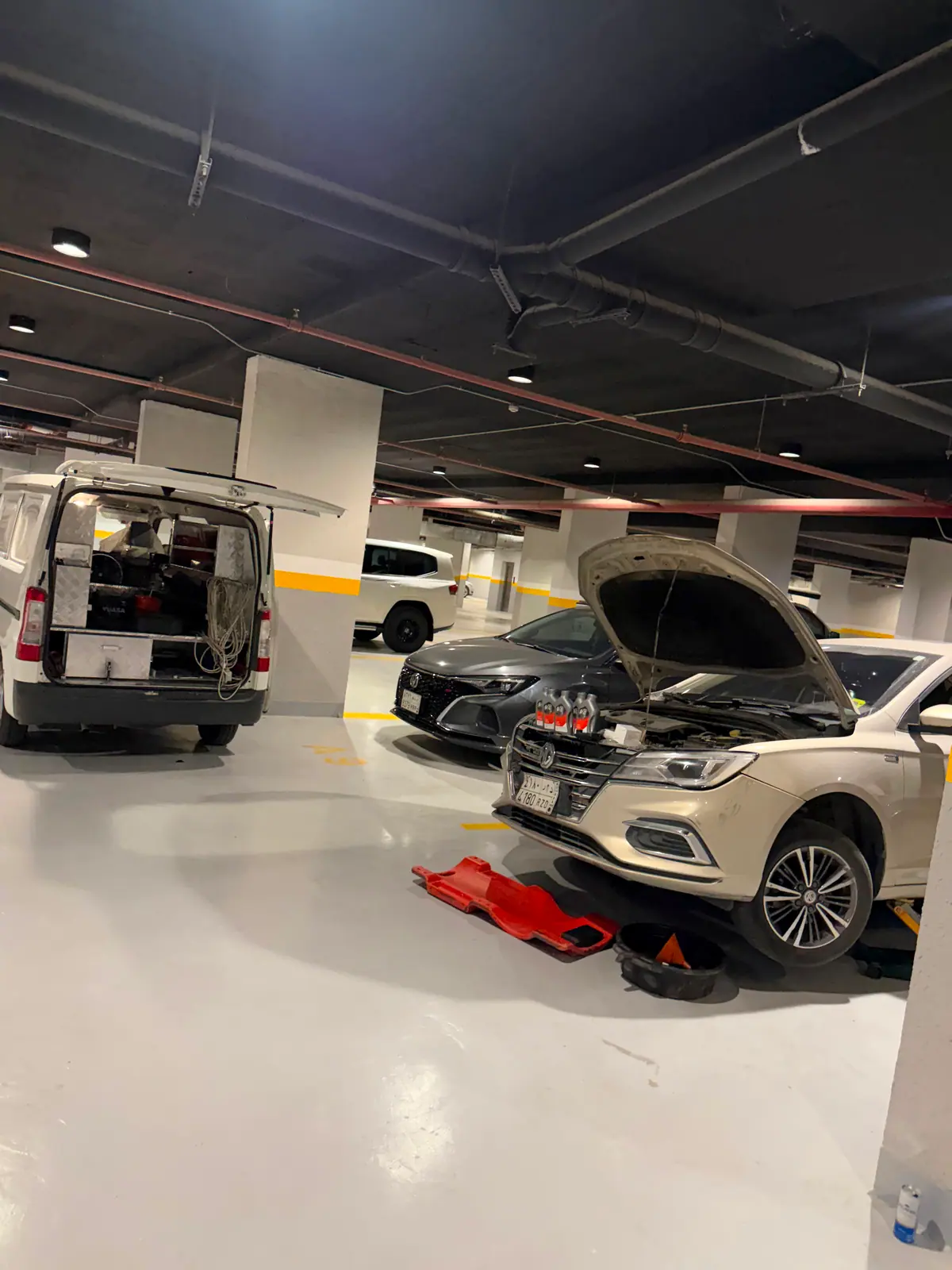
Saaed Service is a mobile workshop in Riyadh. A technician drives to your villa driveway, compound car park or office basement, works through the items due at your mileage and the season, shows you what was found rather than describing it, and tells you plainly when something genuinely needs a lift and a fixed workshop. We work 24 hours a day, every day including Fridays, Ramadan nights and Eid, and reach most Riyadh addresses in around 10 minutes. Call or WhatsApp +966 57 970 1115 in Arabic or English. The price is agreed before we start, and nothing is added to it — cash, card or bank transfer.
More guides for Riyadh drivers
Mobile Car Repair vs a Workshop
What gets finished at your kerb, what genuinely needs a lift, and how to tell the two apart quickly.
Read guide Buying & adviceGenuine vs Fake Car Parts in Riyadh
The difference between genuine, OEM, quality aftermarket and counterfeit — and how to check before a part goes on.
Read guide ServicingRiyadh summer checklist: do it before June
Nine checks, spread over three months, that stop most Riyadh summer breakdowns before they start.
Read guideQuestions drivers ask
Follow the manual's severe-service schedule, which almost every manual contains. Sustained high temperature, dust, extended idling and short trips are the listed severe conditions, and Saudi driving involves most of them for most of the year. That schedule is the manufacturer's own recommendation, not an upsell — it is simply printed further down the page than the headline figure people read.
Batteries, air conditioning components, rubber and plastic. Heat shortens battery life to two or three years, cooks hoses, belts, bushes and wiper blades, and works AC systems hard enough to expose every weak seal. Dust blocks air filters, cabin filters and radiator fins. Almost every common failure here traces back to temperature or sand rather than to distance travelled.
No. Time-based items do not care about the odometer. Brake fluid absorbs moisture from the air, coolant inhibitors deplete, oil additives degrade, rubber hardens and batteries age whether the car moves or not. Low mileage usually means short trips too, which is harder on oil than long runs. Work to a calendar: oil every six months, brake fluid every two years, battery tested yearly.
Treat that claim carefully. It generally means the life the manufacturer plans for, under moderate conditions. Saudi traffic, heat and load oxidise gearbox fluid faster than the test conditions behind that claim. Changing fluid and filter on a healthy gearbox around 60,000 to 80,000 km is worthwhile. On a transmission that already slips or shifts harshly, new fluid rarely fixes it, and nobody should promise otherwise.
Have it measured every spring, before the heat. Vent temperature, pressures on both sides and compressor operation tell you whether the system is healthy or slowly losing refrigerant. A system that is a little weak in March will not cope in July. If it needed gas last year and needs it again this year, there is a leak, and adding refrigerant without finding that leak just pays for the same gas twice.
Check alignment yearly, after any significant kerb or pothole impact, and whenever the car pulls or a tyre wears unevenly on one shoulder. Riyadh has plenty of high kerbs, speed humps and construction-edge drops that knock angles out. The check and the tyre wear reading can be done at the car; the actual adjustment needs a proper alignment rig on level ground.

Rather we just handled it?
Call +966 57 970 1115 and a mobile technician comes to your car anywhere in Riyadh — 24/7, price agreed first.