

Why Is My Car Overheating in Riyadh, and What Do I Do First?
A rising temperature gauge is a specific message, not a general complaint. Where the needle climbs — in traffic or at speed — tells you which half of the cooling system has failed.
If the needle climbs in slow traffic and drops again once you are moving, the problem is airflow: a dead cooling fan, or a radiator and AC condenser packed with Riyadh dust. If it climbs at steady speed on the ring road, the problem is inside the system — low coolant, a thermostat stuck closed, or a failing water pump. Either way, switch the AC off, put the cabin heater on full hot, get off the road safely, and never open a hot cap.
A temperature gauge that has sat in the same place for two years and suddenly starts creeping up is telling you something specific. It is not a vague warning that the car is unhappy. Coolant temperature only rises when heat enters the engine faster than the cooling system carries it away, and there are a limited number of reasons for that. Reading the pattern — when the needle climbs and when it recovers — narrows the cause to one or two parts before anybody opens the bonnet.
Riyadh makes every one of those failures both more likely and less forgiving. Air near 48°C in July leaves the radiator far less temperature difference to work with, so it needs full airflow and full coolant volume just to hold normal. Fine sand packs the gap between the AC condenser and the radiator core until air stops passing through. Long idles on King Fahd Road and in basement car park queues remove the ram air the system was designed around. A cooling system that would cope in a mild climate has no margin here.
What the temperature gauge is actually telling you
The gauge reads coolant temperature at one point, usually where coolant leaves the cylinder head. Most modern cars deliberately damp that needle and hold it in the middle across a wide band, often 85°C to 105°C, so drivers do not panic at normal variation. That damping matters. By the time the needle has visibly moved above where it always sits, the real temperature has usually risen far more than the movement suggests. Any climb above its normal position is a genuine event, not a quirk of the gauge.
A red warning light, or a needle in the red zone, is a later stage again. On many cars that light appears around 118°C to 120°C, which is past the point where the head gasket, the aluminium head and the piston rings begin taking damage. Some cars now cut power, enter limp mode and display a message instead of moving a needle at all. If your car shows a digital coolant temperature, note the number. That figure, together with what the car was doing at the time, is the most useful thing you can tell a technician.
Climbing in traffic versus climbing at speed
This single distinction does most of the diagnostic work. At a standstill or crawling in traffic, almost all airflow through the radiator comes from the cooling fan. If the fan motor, its relay, its control module or the viscous fan clutch has failed, the car will be perfectly normal at 100 km/h on the Eastern Ring Road and start climbing within minutes of stopping at lights. Switching the AC on puts the condenser in front of the radiator adding heat, which is why this pattern almost always shows itself first with the AC running.
Climbing at steady speed points the other way. At 100 km/h far more air passes through the radiator than any fan can produce, so airflow is not the limiting factor. What remains is the coolant side: not enough coolant in the system, a thermostat stuck closed, a water pump impeller that has corroded away or a slipping pump belt, or a radiator core blocked internally with scale. A car that overheats on the open ring road but behaves around town is telling you the coolant is either not circulating or not there in sufficient volume.
- Needle rises in traffic and falls once you are moving — cooling fan, or radiator and condenser fins blocked with dust
- Needle rises at steady speed on the ring road — low coolant, stuck thermostat, water pump or a blocked core
- Heater blows cold air when the engine is hot — a classic sign coolant has dropped below the heater core
- Expansion tank empty this month after being full last month, with no puddle under the car
- A sweet syrup smell through the vents or around the front of the car after parking
- Steam or hissing at the edge of the bonnet, or a whistle as pressure escapes past the cap
The first two minutes: what to do the moment the needle moves
The goal is to remove heat load and get out of traffic without creating a second emergency. Switch the air conditioning off immediately — the compressor is load on the engine and the condenser is effectively a heater sitting in front of your radiator. Then turn the cabin heater to full hot with the blower at maximum. It is miserable in July and it genuinely works: the heater core is a second small radiator, and it can pull a useful amount of heat out of the engine while you find somewhere to stop.
Do not shut the engine off while you are still rolling, and do not sit in a queue hoping it clears. Coolant only circulates while the pump turns, so an engine switched off at peak temperature soaks heat into the head with nothing carrying it away. Move right, take the next exit or get well onto the shoulder, hazard lights on, then let it idle for about a minute before shutting down. The exception is steam, a burning smell or a needle already in the red — in that case stop and switch off now.
- AC off, cabin heater on full hot with the fan at maximum
- Hazard lights on, move right, and get off the carriageway or well onto the shoulder
- Keep creeping forward if you safely can — movement beats sitting still with a dead fan
- Idle for roughly a minute before shutting down, unless you see steam or the gauge is in the red
- On a ring road shoulder, get everyone out on the far side of the barrier, never the traffic side
- Release the bonnet catch but leave the bonnet down until the hissing has stopped
Never open a hot radiator or expansion cap
A cooling system is pressurised on purpose. The cap holds roughly 1 to 1.4 bar, and that pressure lifts the boiling point of the coolant from around 108°C to about 125°C or higher. It is the only reason the liquid stays a liquid at temperatures that would otherwise turn it to steam inside the cylinder head. Release that pressure while the engine is hot and the superheated coolant flashes to steam instantly, blowing out of the neck and carrying boiling liquid with it. This is the most common way drivers are seriously burned by their own car.
So wait it out. On a 45°C Riyadh afternoon an engine bay sheds heat slowly — give it at least 45 minutes, longer if the car is standing in full sun. On most modern cars the expansion tank cap is the pressure cap, so there is no safe shortcut for topping up sooner. When it has cooled, use a thick cloth, turn the cap to its first stop only, stand to one side and let any remaining pressure hiss away before removing it. Never pour cold water into a hot engine either; the thermal shock can crack a head or a block.
Why plain water instead of coolant destroys systems here
Adding water in a genuine emergency to reach somewhere safe is reasonable. Running on water is not. Proper coolant is roughly half glycol and half water plus an inhibitor package, and every part of that mix has a job. The glycol raises the boiling point and lowers the freezing point. The inhibitors coat aluminium, steel and copper so they do not corrode, and they lubricate and protect the water pump seal. Water on its own boils sooner — exactly when Riyadh heat has already pushed the system close to its limit.
The damage that follows is slower and worse than most drivers expect. Local tap water is hard, so it lays scale inside the radiator tubes and the narrow passages in the head, and scale is an insulator: the engine holds its heat instead of shedding it. Without inhibitors the dissimilar metals in the engine set up a small electrical current that eats aluminium from the inside, and the pump seal wears until it weeps. A system run on water through one summer often needs a radiator, a pump and a full flush rather than a bottle of coolant.
Head gasket warning signs after an overheat
The head gasket seals combustion pressure, coolant passages and oil galleries between the block and the cylinder head. Sustained overheating warps an aluminium head just enough to break that seal. Once it goes, combustion pressure is forced into the cooling system, pushing coolant out of the expansion tank and creating air pockets that make the overheating worse — a loop that accelerates. Coolant can also be drawn into a cylinder and burned, or into the oil. This is the repair that overheating is worth avoiding, and it is genuine workshop work, not a roadside fix.
The signs usually appear before the engine finally stops. White exhaust smoke with a sweet smell, still present once the engine is fully warm rather than only on a cold start. A creamy beige deposit under the oil filler cap or on the dipstick. Continuous bubbles rising in the expansion tank at idle with the cap off. Coolant vanishing week after week with nothing on the driveway underneath. A combustion-gas test on the coolant confirms or clears it in a few minutes, and that test can be done at your car.
- White exhaust smoke that smells sweet and is still there once the engine is warm
- Creamy beige sludge under the oil filler cap or along the dipstick
- Bubbles rising continuously in the expansion tank at idle with the cap off
- Coolant level dropping with no puddle under the car and no visible leak
- Overheating that returns within minutes of a top-up
- A rough idle or misfire on one cylinder alongside the coolant loss
Overheating is one of the few faults where the drive to a workshop is the thing that causes the damage. If the gauge is up and you are on the Northern or Eastern Ring Road, on Airport Road, or stuck in a basement car park queue, stop and call rather than pushing on for a few more kilometres. A technician comes to the car with a pressure tester, an infrared thermometer, a scan tool that shows live coolant temperature and can command the fan, and coolant that matches your car's specification.
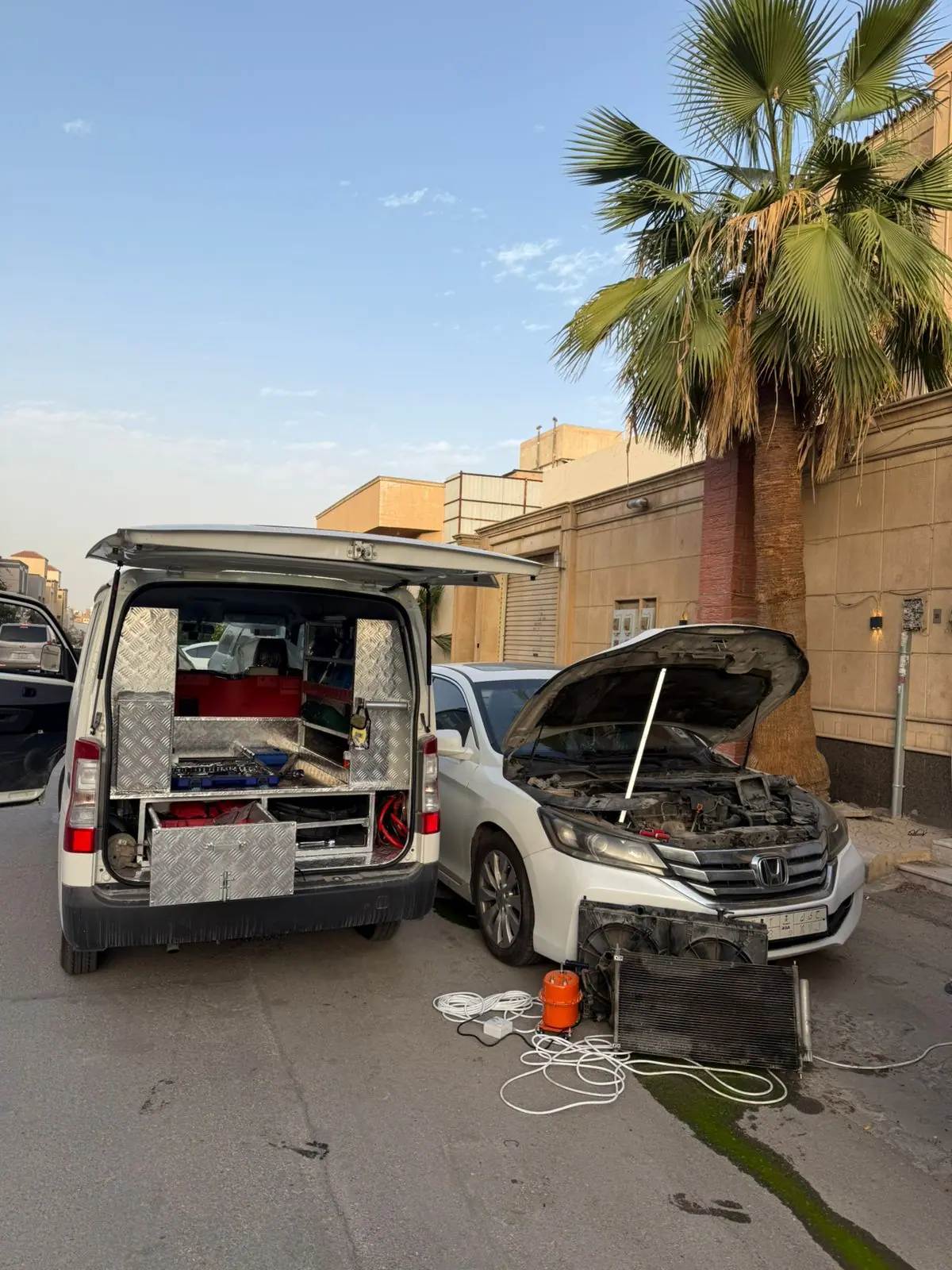
We pressure-test the system for leaks, test the cap, confirm the fan runs on command, check whether the radiator and condenser fins are packed with sand, and run a combustion-gas test on the coolant when a head gasket is in question. Hoses, thermostats, caps, fan motors, radiator flush and refill are all finished on site, anywhere in Riyadh, 24 hours a day. When the honest answer is that the head has to come off, we say so and put the car on a flatbed instead of selling you a repair that will not hold. Call or WhatsApp 057 970 1115, and you hear the price before any work begins.
More guides for Riyadh drivers
Car Won't Start: A Step-by-Step Checklist
Nothing, one click, cranking but no fire, or starts and dies — what each symptom actually means.
Read guide Tyres & wheelsTyre Pressure and Heat in Riyadh
Set them cold to the door placard, read the DOT date, and know why under-inflation is what causes blowouts.
Read guide ServicingOil Change Intervals in Riyadh Heat
Why the interval printed in your manual is the best case, and what heat, dust and short trips really cost oil.
Read guideQuestions drivers ask
Not for long. Because the needle is damped across a wide band, a small visible rise usually means a much larger real rise. Slightly above normal in traffic that recovers when you move is worth investigating this week. Slightly above normal that keeps climbing, or that appears at steady speed on the ring road, means stop at the next safe place. Continuing is how a cheap thermostat becomes a head gasket.
In an emergency, yes — water in a cool system will get you off the ring road, and getting to safety matters more than the coolant mix. But treat it as a rescue, not a repair. Have the system drained and refilled with the correct coolant within days. Also find why the level dropped: coolant does not evaporate, so a low system means a leak, a leaking cap, or gas entering the system.
The AC condenser sits directly in front of the radiator, so the air reaching the radiator is already heated by it, and the compressor adds mechanical load. On top of that, many cars run the cooling fan at a higher speed when the AC is on. If the fan is weak or the fins are blocked with sand, the AC is simply the extra load that exposes it. It points to airflow, not to the AC itself.
More than most drivers expect. Fine sand and dust build up between the AC condenser and the radiator core, in a gap you cannot see without removing panels. Once that layer is packed in, air passes around the core instead of through it. A car can lose a large share of its cooling capacity with no failed part at all. A careful flush of the fins from the engine side outwards often restores it.
It usually means the coolant level has fallen below the heater core, or air is trapped in the system. The heater core sits high in the circuit, so it is one of the first things to run dry. It is a useful clue: it points to lost coolant or trapped air rather than a fan fault, and it means the system needs finding, filling and bleeding properly rather than simply topping up.
Most of them, yes. Split hoses, failed clamps, a weeping cap, a leaking expansion tank, a thermostat housing and many radiator hose connections are replaced at your car. A pressure test finds the leak quickly. A corroded radiator core, a water pump behind a timing cover, or a suspected head gasket is different work, and for those we recommend a flatbed to a workshop rather than a temporary patch.

Rather we just handled it?
Call +966 57 970 1115 and a mobile technician comes to your car anywhere in Riyadh — 24/7, price agreed first.