
What Tyre Pressure Should You Run in Riyadh Summer?
Pressure rises as a tyre heats, which is why you set it cold and leave it alone. The tyres that fail in a Riyadh July are the soft ones, not the hard ones.
Set your tyres cold — parked three hours or driven less than about two kilometres — to the figure on the driver's door placard, not the maximum stamped on the sidewall. Pressure rising several psi after a run on the ring road is normal and correct; never bleed air out of a hot tyre. Under-inflation, not over-inflation, is what destroys tyres in Riyadh heat, and in this sun a tyre often ages out at five or six years while the tread still looks fine.
Tyres are the only part of the car touching the road, and pressure is the single setting that decides how well they do it. It changes braking distance, steering response, aquaplaning resistance on the rare wet morning, fuel consumption, tread life and, most importantly in this climate, how hot the tyre gets while you drive. Most drivers set it once a year at a petrol station, in the afternoon, on a hot tyre, guessing at the number. That is three mistakes in one visit.
Riyadh conditions push tyres harder than almost any European or coastal market. Road surface temperature on an open stretch of the Eastern Ring Road in July is far above the 48°C in the air. UV and heat attack the rubber compound while the car is parked. Fine sand scours the sidewalls. Long motorway runs at steady high speed give a tyre no chance to cool. Everything below assumes those conditions, because a tyre habit that is merely careless in a mild climate becomes dangerous here.
Set them cold, to the door placard — not the sidewall
The correct pressure for your car is printed on a placard, usually on the driver's door pillar, sometimes inside the fuel filler flap or in the glovebox. That figure was chosen by the manufacturer for your car's weight, suspension and tyre size. The large number moulded into the tyre sidewall is something else entirely: it is the maximum pressure the tyre construction can hold, not a recommendation. Inflating to the sidewall maximum gives you a hard ride, a narrow contact patch worn down the centre, and less grip when you brake hard.
Cold means genuinely cold: the car parked for at least three hours, or driven less than about two kilometres at low speed. In Riyadh the only realistic time is early morning, before the sun has been on the tyres and before a real drive. Checking at a petrol station at 3pm after twenty minutes on King Fahd Road gives you an inflated reading, and if you set it to the placard figure while hot, the tyre is badly under-inflated by the next morning. If you must check hot, do not remove air to reach the placard number.
- Find the placard on the driver's door pillar, the fuel flap or the glovebox — not the sidewall
- Check early morning, before the sun hits the tyres and before driving more than about two kilometres
- Use your own gauge; forecourt gauges are abused daily and are often several psi out
- Check all four, and check the spare — a flat spare is discovered at the worst possible time
- Note the loaded figure on the placard if you are carrying passengers and luggage
- Reset the TPMS after adjusting, if your car requires it
Why heat raises pressure, and why that is fine
Air expands as it warms. As a rough rule, pressure inside a tyre changes about 1 psi for every 5°C change in the air inside it. A tyre that sat overnight at 30°C and then ran for half an hour on hot asphalt can easily be 15°C to 25°C warmer inside, so a tyre set to 33 psi cold might read 38 or 40 psi hot. Nothing has gone wrong. That rise is designed in — the placard figure already accounts for a tyre that will spend its working life warm.
This is why bleeding air out of a hot tyre is one of the worst things you can do. Let out enough to bring a hot tyre back down to the placard number and you have removed real air. By next morning that tyre is five or six psi below where it should be, running soft, flexing more, generating more heat, and heading exactly towards the failure you were trying to avoid. Set cold, then leave it alone. The number moves during the day, and it is supposed to.
Under-inflation, not over-inflation, is what causes summer blowouts
A blowout in July is almost never a tyre that was pumped too hard. It is a tyre that was soft. An under-inflated tyre has a sidewall that flexes further on every single rotation, and each flex generates heat inside the rubber and the steel belts. At 120 km/h that is happening around fifteen times a second, on a surface already too hot to touch. The heat builds faster than the tyre can shed it, the rubber softens, the bond between the belts and the carcass weakens, and eventually the belt separates and the tyre lets go.
The failure often starts silently. A slow puncture from a screw picked up on a construction road, a corroded rim that leaks past the bead, a leaking valve stem — the tyre drops a few psi a week and nobody notices because it still looks round. Then a full car, a long run on the Northern Ring Road, and the heat finally wins. This is why a two-minute pressure check every couple of weeks does more for your safety than almost any other maintenance you can do yourself.
- Wear along both outer shoulders with the centre still good — chronic under-inflation
- Wear down the centre strip only — running consistently over-inflated
- One tyre that always needs air while the others hold — puncture, valve or rim leak
- The TPMS light appearing only on cold mornings, then clearing — the tyres are borderline low
- A hum or vibration that changes with speed but not with braking
- Cracks or a bulge in the sidewall, or a sidewall noticeably hotter than the others after a drive
Reading the DOT date code, and why tyres age out here
Every tyre carries a DOT code on the sidewall ending in four digits. The first two are the week of manufacture and the last two are the year, so 2223 means the twenty-second week of 2023. On many tyres the full code appears on one side only, so check both. It takes ten seconds per wheel and it is the single most useful thing most drivers have never looked at, especially when buying a used car or a set of tyres that was sitting in a warehouse.
Rubber ages chemically whether you drive or not. Heat and ultraviolet break down the compound and the oils in it migrate out, so the tyre hardens, loses grip and starts to crack. In Riyadh, with cars parked on open tarmac under direct sun for months, that process runs far faster than the mileage does. It is completely normal here for a tyre to be unsafe with most of its tread still present. Inspect closely from year five, and treat six years as the point to replace regardless of how the tread looks.
Load ratings, big SUVs and full cars
After the size on the sidewall there is a number and a letter: the load index and the speed rating, for example 103V. The load index is how much weight one tyre can carry at its maximum rated pressure, and the speed rating is the speed the construction was tested to sustain. Both matter more on a heavy seven-seat SUV than on a small saloon, and fitting a lower load index than the placard specifies because it was the tyre in stock is a real safety compromise, not a technicality.
Weight also changes the pressure you need. Many placards list two figures — a normal one and a higher one for a fully loaded car. A large SUV with seven people and luggage for a weekend out of the city is a genuinely different vehicle from the same SUV with one driver, and the rear tyres in particular need the loaded figure. Set it before you load up, drop back to the normal figure afterwards, and never let a heavily loaded car run at the light-load number in summer.
What to do when a tyre blows out at speed
A front blowout drags the steering hard to that side; a rear blowout makes the back of the car feel loose and start to sway. The instinct in both cases is to brake hard and steer away from it, and both of those instincts are wrong. Hard braking shifts weight forward and can spin a car that has already lost grip at one corner. Instead, grip the wheel firmly with both hands, hold your line straight, and lift off the accelerator gradually rather than snapping off it.
Let the car slow itself. Once the speed is down to something walking-pace-slow and stable, steer gently towards the right shoulder and only then use light braking. Hazard lights on. On the Northern or Eastern Ring Road the shoulder is narrow and traffic is passing at 120 km/h, so get everyone out on the far side of the barrier, not the traffic side, and stand well back from the car. Put the warning triangle out behind you, then call for help rather than changing a wheel in a live lane.
- Both hands on the wheel, hold straight — do not steer sharply against the pull
- Lift off the accelerator gradually; no hard braking while the car is still fast
- Let it slow itself, then ease onto the right shoulder and brake lightly
- Hazard lights on, and get everyone out on the far side of the barrier
- Warning triangle well back behind the car, further on a fast ring road
- Do not attempt a wheel change with the car sitting in or beside a live lane
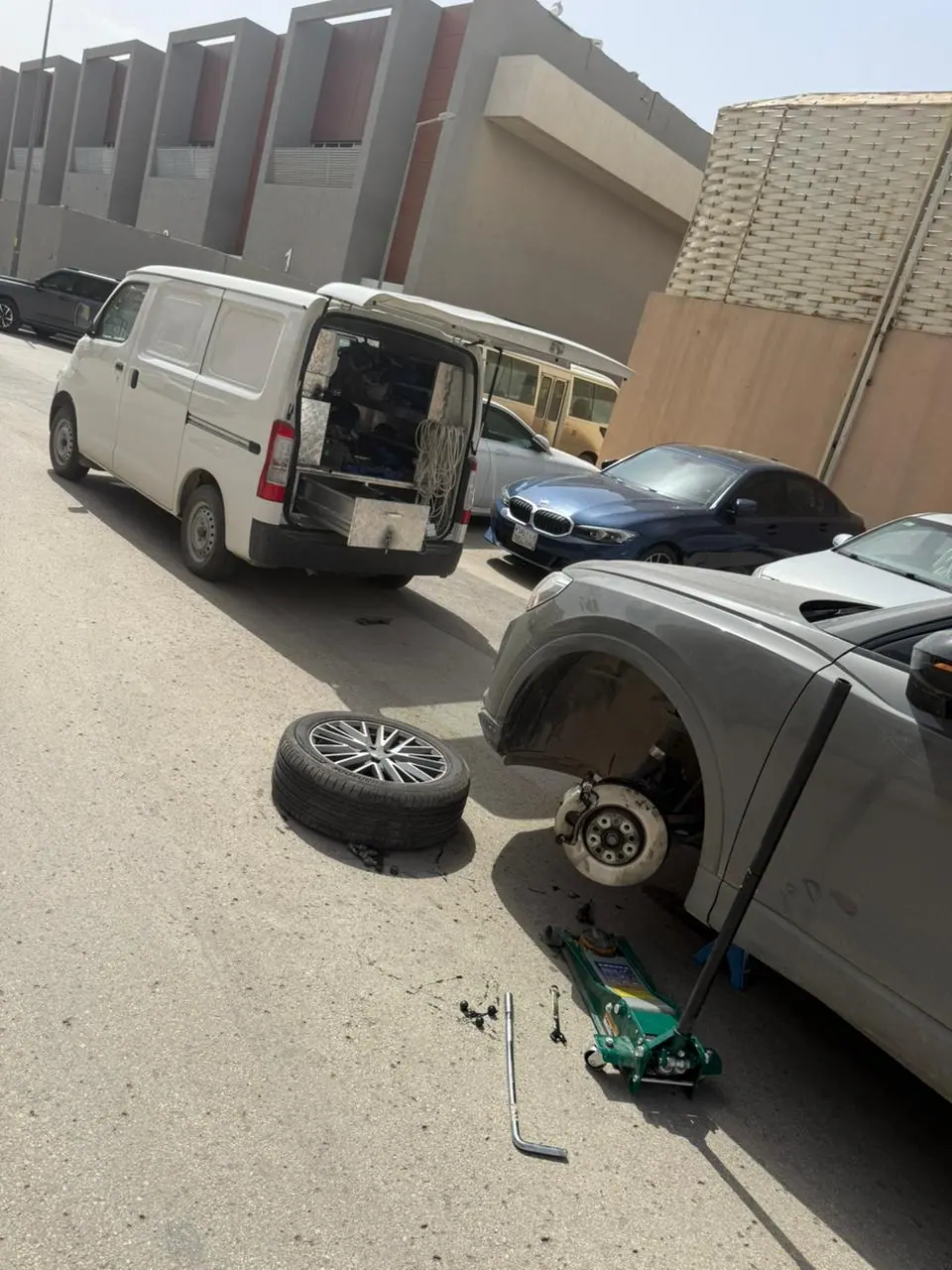
Punctures happen at the worst times here — a screw picked up beside a construction site, a sidewall taken out by a kerb in a basement car park, or a slow leak that finally gives up at midnight on the ring road. We come to the car with a compressor, plugs and patches, a torque wrench and the tools to break a bead down properly, anywhere in Riyadh, 24 hours a day including Fridays, Ramadan and Eid.
On site we repair repairable punctures the correct way from inside the tyre, fit and balance your spare, set all four pressures cold to your placard, reset the TPMS, and tell you honestly when a tyre is finished. A sidewall cut, a bulge, belt separation or heat damage cannot be repaired safely by anyone, and we will say so rather than plug it and wave you off. If the car cannot be made safe to drive, our flatbed moves it. Call or WhatsApp 057 970 1115 — we usually reach most Riyadh addresses in around 10 minutes, and the price is agreed before we start.
More guides for Riyadh drivers
Oil Change Intervals in Riyadh Heat
Why the interval printed in your manual is the best case, and what heat, dust and short trips really cost oil.
Read guide DiagnosticsThe Check Engine Light, Explained
Steady versus flashing, why a cheap code reader misleads you, and the faults that trigger it in Riyadh.
Read guide BrakesBrake Warning Signs and What They Mean
Squeal, grinding, judder, a soft pedal or pulling to one side — and which of them mean stop driving today.
Read guideQuestions drivers ask
No — that is the most common and most dangerous tyre myth in this climate. Lower pressure means more sidewall flex, which means more heat, which is exactly what causes a summer blowout. The placard figure is a cold figure that already assumes the tyre will run hot. Set it cold to the placard and leave it. If anything, run at the loaded figure when the car is full.
Every two weeks, and always before a long run out of the city. Tyres lose pressure naturally, roughly a psi a month, and faster in heat or with an ageing valve. Two weeks is often enough to catch a slow puncture before it becomes a heat problem. Check cold in the early morning, and include the spare — a spare that has sat for three years is often too flat to use.
Because the tyres are borderline low. Cold overnight air means low pressure, the sensor trips, then driving warms the tyres, pressure rises back over the threshold and the light clears. The system is doing its job and telling you the cold pressure is below specification. Do not wait for it to stop appearing — set all four cold to the placard figure and the light should stay off.
No. The sidewall flexes on every rotation and carries the structural load, so no plug or patch will hold there safely. The same applies to a bulge, a cut that reaches the cords, or a tyre that has been run flat and overheated. Only a puncture in the central tread area, within the repairable width and not previously repaired at that spot, can be fixed — and it should be repaired from the inside, not with an external plug alone.
Inspect carefully from five years and plan to replace at around six, regardless of tread depth. Heat and ultraviolet harden the rubber and drive out the oils that keep it flexible, and cars here spend months parked in direct sun. Look for fine cracking between the tread blocks and along the sidewall. A hard, aged tyre with good tread has noticeably longer braking distances than a fresh one.
Both. We repair punctures on site, fit your spare, and can bring and fit a new tyre when you tell us the full size from the sidewall and the DOT code situation on the others. We balance the wheel after fitting and torque the nuts to specification. If a car needs an alignment check afterwards because of what caused the damage, we tell you rather than leaving you to discover it through uneven wear.

Rather we just handled it?
Call +966 57 970 1115 and a mobile technician comes to your car anywhere in Riyadh — 24/7, price agreed first.