

What Does the Check Engine Light Actually Mean?
The engine light is not a fault. It is a message saying the engine control unit measured something outside its expected range and stored the evidence. Whether it is flashing decides what you do next.
A steady check engine light means drive carefully and get it read soon — the car has stored a fault but is not destroying itself. A flashing light means stop as soon as it is safe: that is an active misfire dumping raw fuel into the exhaust, which can wreck an expensive catalytic converter in minutes. Either way the code names a symptom, not a cause, and clearing it without diagnosis just deletes the evidence.
Every car built since the late 1990s runs a self-diagnosis system. Dozens of sensors report to the engine control unit, which compares each reading against what it expects for that engine speed, load and temperature. When something stays outside those limits for long enough, the ECU stores a fault code, saves a snapshot of the conditions at that moment, and turns on the amber engine symbol on your dash.
That is all the light says: something is out of range. It does not say which part has failed, and it does not tell you the repair. It could be a fuel cap that was not tightened at the pump, a sensor cooked by a Riyadh August, a coil breaking down under load, or a genuine mechanical problem. The only thing you can read from the dash alone is whether the light is steady or flashing — and that distinction matters more than anything else in this article.
Steady light versus flashing light
A steady amber light means a fault is stored and the car has decided it can continue running. You do not need to abandon the car on the Northern Ring Road. You do need to get it read within days rather than months, because many stored faults quietly make something else worse — a lean mixture runs hotter, a slipping sensor reading wastes fuel, a small leak becomes a big one. Keep an eye on temperature and oil pressure while you drive it.
A flashing light is a different instruction entirely. It means an active misfire severe enough that unburned fuel is passing straight into the exhaust. That raw fuel ignites inside the catalytic converter, and the converter's internal temperature can climb far beyond design within a few minutes. The result is a melted substrate — one of the more expensive repairs on a modern car, caused by continuing to drive when a much cheaper coil or plug was the original fault.
- Flashing light: pull over safely, switch the engine off, do not keep driving to reach a workshop
- Flashing light plus a shudder or loss of power: an active misfire, almost certainly ignition or injection
- Steady light and the car drives normally: book a proper scan, keep driving gently in the meantime
- Steady light with rising temperature gauge: treat it as urgent and stop, this is not a sensor problem
- Light plus a burning or fuel smell: stop, this needs looking at before another kilometre
- Light that came on right after refuelling: check the fuel cap is clicked tight before anything else
What the light is actually monitoring
Most engine lights are emissions-related, because the system was built for emissions compliance. The ECU watches the oxygen sensors before and after the catalytic converter, the air mass entering the engine, fuel trim, misfire counts per cylinder, evaporative system pressure, and dozens more parameters. When the numbers stop agreeing with each other, the ECU cannot know which component lied. It only knows the maths no longer works.
This is why the code language is worded the way it is. A code does not say the mass airflow sensor has failed. It says the system detected airflow outside expected range, or the mixture is too lean at part load, or catalyst efficiency is below threshold. Those are observations. Turning an observation into a repair is the actual diagnostic work, and it needs live data and a technician's judgement, not a translation of the code number into a part name.
Why a cheap code reader gives a symptom, not a cause
A basic reader plugged into the port under the dash will show you the stored code and offer a short description. That is genuinely useful information and worth having. What it cannot do is tell you why the code is there. Take P0171, system too lean. That single code can come from a split intake hose, a dirty air mass sensor, a weak fuel pump, a blocked filter, a leaking injector, a failing oxygen sensor, or an exhaust leak upstream of the sensor. Seven different repairs, one code.
The same applies to P0420, catalyst efficiency below threshold. Most drivers hear catalytic converter and assume the converter is finished. Often it is not: a lazy rear oxygen sensor, an exhaust leak, or an engine that has been misfiring for months will produce the same code with a perfectly good converter. A proper diagnosis reads live sensor voltages while the engine runs, compares fuel trim at idle and at load, and looks at the freeze frame data before recommending anything expensive.
What sets it off most often in Riyadh
Heat and dust dominate the list here. Sensors are electronic components living in an engine bay that reaches extreme temperatures in July, and the ones that fail early are the ones mounted hottest — oxygen sensors in the exhaust, the crankshaft and camshaft position sensors, and ignition coils that break down only once they are hot and under load. A coil that works fine cold and misfires at 120 km/h on Airport Road in August is a routine Riyadh fault.
Dust is the other half. Fine sand loads an air filter far faster than any service schedule assumes, and once the filter is loaded, airflow readings drift and the mixture goes wrong. Sand also contaminates the mass airflow sensor wire and settles in the throttle body. Then there is the simplest cause of all: an evaporative system code from a fuel cap left loose at the pump, or a cap whose rubber seal has hardened and cracked in the heat.
- Oxygen sensors aged early by exhaust heat, giving lazy or drifting readings
- Ignition coils that break down only when hot and loaded — misfire codes that appear at speed
- Air filters loaded with fine dust long before the service interval says they should be
- A dirty mass airflow sensor wire, causing lean or rich codes and poor throttle response
- Loose or cracked fuel cap seals triggering evaporative emission codes
- Catalyst efficiency codes after months of driving with an untreated misfire
- Crank and cam position sensors failing once heat-soaked, sometimes with a no-start as well
What to do in the first ten minutes
Start with what is free. If the light appeared immediately after a fuel stop, pull over and check the cap is clicked properly closed — evaporative codes from a loose cap are common and often clear themselves after a few drive cycles once the cap seals. Note whether anything changed in how the car drives: rough idle, hesitation, a shudder under acceleration, worse fuel consumption, a smell. That description is worth as much to a technician as the code number.
Then check the things you can see. Coolant level in the expansion tank when the engine is cold, oil level on the dipstick, and whether the temperature gauge reads normally. If the light is steady, the car drives normally and the fluids are fine, you can carry on driving gently and get it scanned properly within a few days. If anything on the list below is true, treat it as a stop-now situation instead.
- Check the fuel cap is fully tightened if the light appeared just after refuelling
- Write down exactly when it came on: cold start, at speed, after a hill, after refuelling, in traffic
- Note any change in idle, power, fuel consumption or smell to describe to the technician
- Check coolant and oil levels once the engine is cold, and watch the temperature gauge
- Avoid heavy loads, high speed and towing until it has been read
- Do not clear the code, and do not let anyone clear it before recording what was stored
Why clearing the code is the worst option
Clearing a code deletes three things at once: the fault code itself, the freeze frame snapshot showing engine speed, load, temperature and fuel trim at the exact moment the fault was recorded, and the readiness monitors that show which self-tests the car has completed since. The freeze frame is often the most valuable diagnostic data in the whole system, because it says whether the fault happened cold, hot, at idle or under load. Once deleted, it is gone.
The light also comes back. Erasing a code does not repair anything — it just resets the counter, and the ECU will store the same fault again as soon as the same conditions occur, usually within a few drive cycles. Meanwhile a car with freshly cleared monitors cannot pass an inspection that checks them until it has completed enough driving to run its self-tests again. If a shop offers to clear the light instead of diagnosing it, that is a warning about the shop, not a solution.
The honest summary is short. Flashing means stop. Steady means get it read properly, soon, by someone who looks at live data rather than reading a code number off a screen and quoting a part. And nobody should clear the code before the evidence has been recorded.
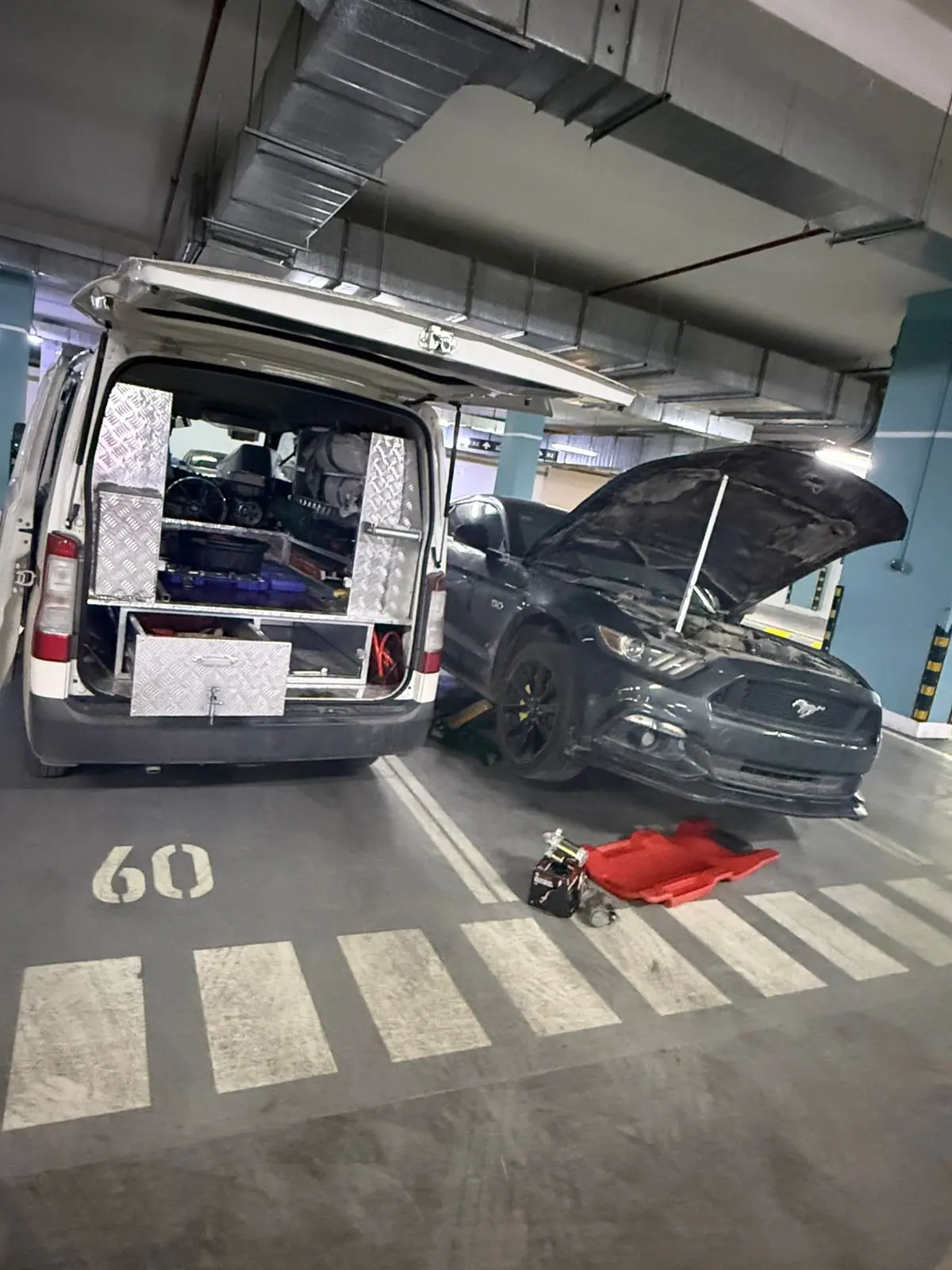
Saaed Service brings the scan tool to your car. Our technician connects at your villa, office car park or on the roadside, reads stored and pending codes with the freeze frame data, checks live sensor values and fuel trims with the engine running, and explains in plain Arabic or English what the car is actually reporting. Many faults — sensors, coils, filters, leaks and connectors — are fixed on the spot. When a job genuinely needs a workshop lift, we say so instead of guessing, and we can arrange flatbed recovery. We work 24 hours a day, all week including Fridays, Ramadan and Eid, and reach most Riyadh addresses in around 10 minutes. Call or WhatsApp +966 57 970 1115. You hear the price before any work begins.
More guides for Riyadh drivers
Brake Warning Signs and What They Mean
Squeal, grinding, judder, a soft pedal or pulling to one side — and which of them mean stop driving today.
Read guide RoadsideBreaking Down on the Riyadh Ring Road
The safe order of actions on the Northern or Eastern Ring Road, and exactly what to say when you call.
Read guide ServicingCar Maintenance Schedule for Saudi Roads
What to service every 5k, 10k, 20k, 40k and 60k km in Saudi heat and dust, and what fails first here.
Read guideQuestions drivers ask
If it is steady, the car drives normally and the temperature gauge is fine, yes — drive gently and get it scanned within a few days. If it is flashing, stop as soon as it is safe. A flashing light means an active misfire sending raw fuel into the exhaust, and that can destroy the catalytic converter within minutes of continued driving.
No, and that is the most common misunderstanding. A code describes a measurement outside its expected range, not a failed component. P0171 means the mixture is too lean, which could be an intake leak, a dirty airflow sensor, a weak fuel pump or a faulty oxygen sensor. Turning that observation into a repair takes live data, not a parts catalogue.
Usually not. A fuel cap that was not clicked tight, or one with a hardened seal, lets the evaporative system lose pressure and the ECU stores a leak code. Tighten the cap properly and the light will often go out by itself after several drive cycles. If it stays on after that, the leak is somewhere else in the system and needs a smoke test to find.
Many faults are intermittent, especially heat-related ones. A coil or sensor that only misbehaves at full engine bay temperature will trigger the light on a hot afternoon and stay quiet on a cool morning. The ECU also turns the light off after a set number of clean drive cycles while keeping the code stored as history. Those stored codes are still readable, which is why a scan is worth doing even after the light goes out.
As an early warning, yes. Knowing whether the stored code is an evaporative leak or a misfire tells you how urgent the situation is, and that is useful. Just do not treat the description on the screen as a diagnosis, and resist the erase button. Deleting the code removes the freeze frame data that makes the fault findable later.
In most cases, yes. Reading codes, freeze frames and live sensor data only needs a proper diagnostic tool plugged into the port under the dash, and that works just as well in a driveway or car park as on a workshop floor. What a workshop is really needed for is heavy mechanical work — pulling a gearbox, opening an engine, or lifting the car for exhaust repairs.

Rather we just handled it?
Call +966 57 970 1115 and a mobile technician comes to your car anywhere in Riyadh — 24/7, price agreed first.