

Why is my car AC blowing warm air in Riyadh?
Warm air at a Riyadh traffic light is a symptom, not a diagnosis. Six faults produce it, and you can narrow the list down before anyone opens the bonnet.
A car AC that blows warm in Riyadh is almost always one of six things: low refrigerant from a slow leak, a condenser packed with dust, a radiator fan that is not running, a compressor clutch that never engages, a cabin filter choking the airflow, or a blend door stuck on heat. You can separate them from the driver seat by asking two questions: does it cool at speed but die in traffic, and is the air weak or simply warm. Adding gas without finding the leak is the one repair that always comes back.
Riyadh gives an air conditioner no rest. From late April the system runs at full load for hours, the condenser has to dump heat into air that is already near 48°C, and fine sand packs the front of the car. So when the vents go warm, drivers assume the gas has run out and go looking for a top-up. Sometimes that is right. Often it is not, and the top-up hides the real fault for a few weeks before the same warm air comes back.
This guide walks through the six faults we actually find, in the order they show up on the van. Everything here can be checked in a villa driveway or a basement car park with the bonnet open and the engine running. You do not need gauges for most of it. Knowing which fault you have before you call anyone means you cannot be sold a re-gas the car does not need.
First test: does it cool at speed but die at a standstill?
This single question splits the six faults into two groups. Drive a few kilometres on the Northern or Eastern Ring Road at a steady speed, then come off and sit at a light. If the vents were cold on the ring road and turn warm within a minute of stopping, the refrigerant charge is probably fine. What has failed is the car's ability to shed heat at the front while standing still. At speed, air is forced through the condenser whether the fan works or not. In traffic, the fan is the only thing moving air, and Riyadh traffic gives you plenty of standing still.
If the air is equally warm at 120 km/h and at a standstill, the problem is inside the loop rather than in front of it: low refrigerant, a compressor that is not turning, or a blend door feeding you heater air. Do the test on a normal day, not immediately after the car has baked in the sun for six hours. A cabin at 70°C takes several minutes to pull down even with a perfect system, and plenty of healthy cars get condemned on that first minute alone.
- Park in shade, start the engine, AC on max, fan on max, recirculation on so outside air is shut out
- Open the bonnet and look at the compressor pulley at the front of the engine
- The centre plate should snap in with an audible click and spin with the outer pulley
- Look through the grille: with AC on, the radiator fan should run and keep running
- Hold your hand at the centre vent after five minutes and compare it to the outside air
- Repeat the vent check after a run at 80 to 100 km/h and note the difference
Low refrigerant: the leak is the fault, not the gas
Refrigerant is not fuel. It circulates in a sealed loop and nothing consumes it, so a system that is low has a leak. In Riyadh the usual suspects are the O-rings at hose joints, the seam where the condenser tubes meet the end tank after years of stone strikes and vibration, the shaft seal on the compressor, and the service port valves themselves. Heat is what accelerates all of them. Rubber that lives at high head pressure through six months of summer hardens, shrinks and stops sealing, which is why leaks appear years earlier here than in a mild climate.
From the driver seat, a slowly leaking system cools well in the morning and poorly by the afternoon, and cooling gets worse week by week rather than failing overnight. As the charge falls further, the low-pressure switch starts cutting the compressor out, so you hear a click from the front of the engine every few seconds and the air turns cool, then warm, then cool again in a cycle. That short-cycling is the clearest audible sign of a low charge, and it is also the point at which you should stop using the AC.
- Cooling that is good early morning and poor by 2pm, getting worse over weeks
- A click from the engine bay every three to ten seconds with the AC switched on
- Air that cycles cool, warm, cool instead of holding a steady temperature
- Oily dark residue collecting on a hose joint, the condenser face or the compressor nose
- A faint hiss from the dashboard for a second or two after switching the engine off
- The system emptied completely within a year of the last re-gas
Dust: a blocked condenser and a loaded cabin filter
The condenser is the flat radiator-like panel sitting in front of the engine radiator, and it is the first thing Riyadh dust reaches. Sand blows in through the grille, mixes with road film and packs solid between the fins. A face that looks grey and matted rather than open is a blocked condenser. It cannot reject heat, head pressure climbs, and cooling collapses at idle first because that is when airflow is lowest. This is one of the few AC faults you can partly fix yourself: a gentle wash from the engine side outwards, with a garden hose and never a high-pressure jet, which folds the fins flat and makes the problem permanent.
The cabin filter is the other dust casualty, and it produces a completely different symptom. A blocked filter does not make the air warm, it makes the air scarce. If what comes out of the vents is genuinely cold but there is barely any of it, even on maximum fan, look at the filter before anything else. In Riyadh, cabin filters load up in months rather than years, and after a spring dust storm a filter can go from acceptable to solid in a week. It is usually behind the glovebox and it is the cheapest AC repair there is.
The radiator fan and the compressor clutch
A dead radiator fan produces exactly the cool-at-speed, warm-in-traffic pattern described earlier, and it is more common in Riyadh than most drivers expect because the fan runs constantly all summer. Test it with the bonnet open, engine idling and AC on: the fan should start within seconds and stay running. If it does not, the cause may be the motor, the fan relay, the resistor pack or the high-pressure switch that commands it. Keep an eye on the temperature gauge while you test, because a car that cannot cool its AC in traffic often cannot cool its engine either.
The compressor clutch is the second half of this check. With the AC on you should hear a click and see the small centre plate of the compressor pulley lock to the spinning outer pulley. No click at all means the compressor is not being driven, and the reason is usually electrical or protective rather than mechanical: a blown fuse, a failed relay, a broken clutch coil, or the low-pressure switch refusing to allow engagement because the charge has fallen too far. That last case is important, because it means a no-click fault and a leak are frequently the same fault.
When cold air reaches only part of the car: the blend door
Behind the dashboard, a flap called the blend door decides how much air passes over the heater core before it reaches you. On most cars a small electric actuator moves it. When the actuator strips its plastic gears or the door itself jams, the system carries on making cold air perfectly while the dashboard mixes hot air back into it. The refrigerant side is healthy, the gauges read normal, and the driver still gets warm vents, which is why this fault survives two or three pointless re-gases before anyone finds it.
The giveaways are specific. On a dual-zone car, one side of the cabin is cold and the other stays warm no matter what you set. On any car, you may hear a repeated soft clicking or ticking from deep behind the dashboard for a few seconds after you start the engine or change the temperature setting. Sometimes the air is cold on the face vents and hot at the footwell. Any of those patterns point at the dashboard, not at the gas, and no amount of refrigerant will change them.
When it stops being a comfort problem and becomes unsafe
Most of the time a warm AC is only misery. Sometimes it is a warning about something that will strand you. The compressor is driven by a belt that on many engines also drives the alternator and the water pump. A compressor whose bearing or clutch is breaking up can seize, and a seized pulley shreds or throws that belt. When it goes, you lose charging and coolant circulation at the same time, on a ring road, in the heat. A squeal, a grinding rumble or a rattle that changes the moment you press the AC button deserves attention this week, not next month.
The second real risk is the engine itself. If the radiator fan has failed, the AC will disappoint you in traffic and the engine temperature gauge will start creeping up in the same conditions. Watch that gauge. If it climbs above its normal position, switch the AC off immediately, which removes a large heat load from the front of the car, and open the windows instead. And take the cabin seriously in July: an interior with no cooling passes 60°C quickly, so never leave children or elderly passengers waiting in a car you know cannot cool.
- Belt squeal, grinding or rattle that changes when the AC button is pressed
- The engine temperature gauge rising above normal whenever you sit in traffic
- A burning rubber smell or smoke from the front of the engine bay
- The compressor pulley visibly wobbling or its centre plate glowing hot after a short run
- Steam or a sweet smell at the front of the car, which is coolant and not an AC fault
- Any of the above while carrying children or elderly passengers in summer
Work through the tests above and you will usually know which of the six you have before you speak to anybody. If it turns out to be a cabin filter or a matted condenser face, that is a job you can do in your own driveway on a Friday morning, and you should. If the tests point at a leak, a clutch that will not engage or a fan that has stopped, the system needs gauges on both service ports before anything is added to it, because pressures are the only way to separate a low charge from a blockage from an overcharge.
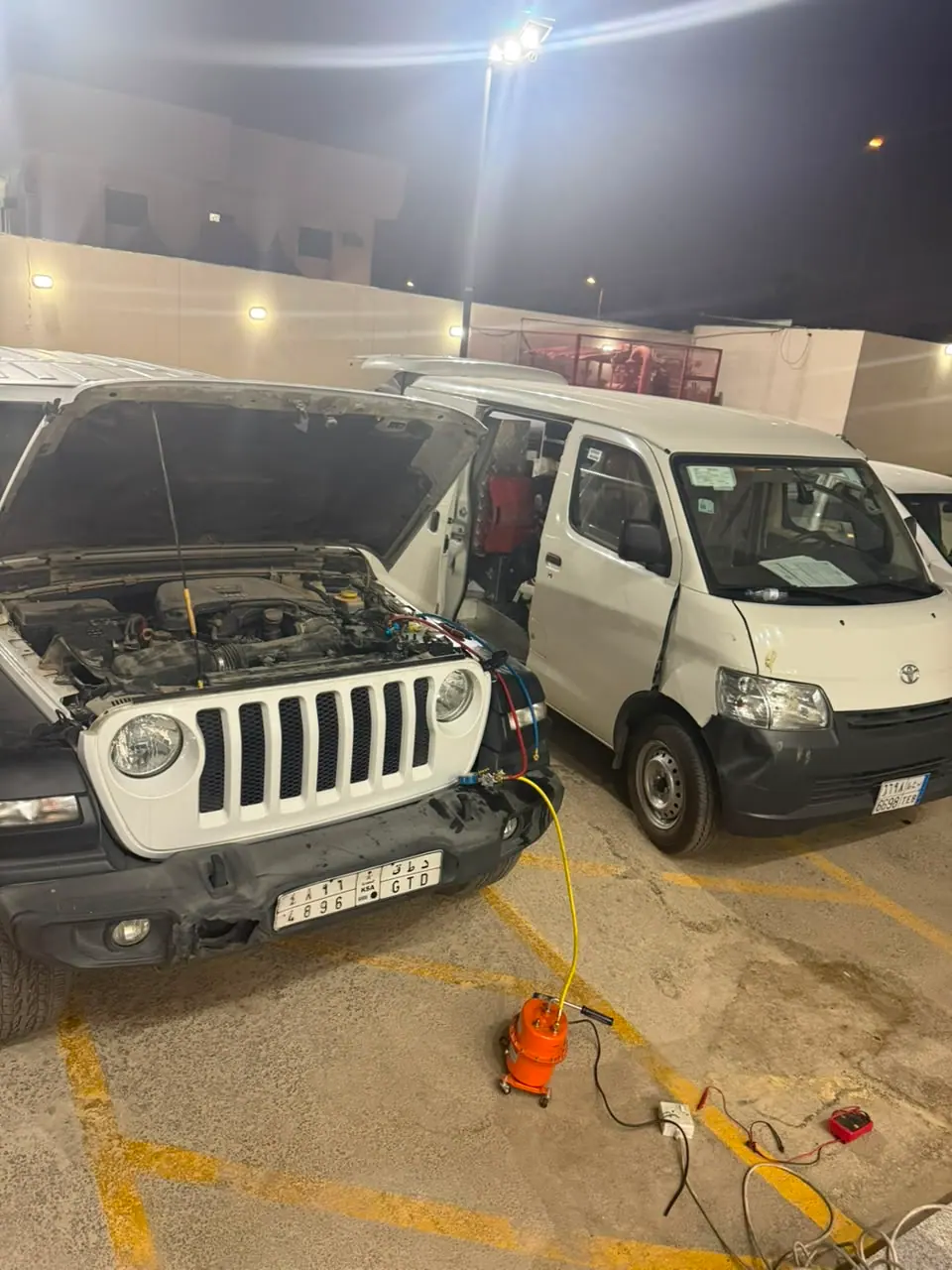
Saaed Service brings that equipment to the car. Our technicians work anywhere in Riyadh, 24 hours a day including Fridays, Ramadan and Eid, and reach most addresses in around ten minutes, whether the car is in a villa driveway, a compound parking bay or a tower basement. We measure first, tell you the cause in Arabic or English, quote one total before starting, and nothing is added to that figure once the vent temperature has been measured in front of you. Call or WhatsApp 057 970 1115. If the honest answer is that your car needs a workshop with a lift, we will tell you that too.
More guides for Riyadh drivers
Car Battery Life in Riyadh Heat
Why Riyadh heat turns a five-year battery into a two-year battery, and how to catch the end early.
Read guide Cooling & overheatingCar Overheating in Riyadh Summer
What the temperature gauge is telling you, the first two minutes that save an engine, and when to stop.
Read guide Battery & startingCar Won't Start: A Step-by-Step Checklist
Nothing, one click, cranking but no fire, or starts and dies — what each symptom actually means.
Read guideQuestions drivers ask
That pattern points at the front of the car, not the refrigerant charge. At speed, air is forced through the condenser regardless of the fan, so cooling holds up. At a standstill the fan is the only source of airflow. Either the fan has stopped running or the condenser fins are packed with sand and cannot shed heat. Check both with the bonnet open at idle before anyone suggests adding gas.
You can, and it is one of the most expensive short cuts available. The cans read low-side pressure only, which tells you almost nothing without the high side and the ambient temperature, so overcharging is normal. Many cans also contain sealant, which sets inside the system and inside recovery equipment. The underlying leak stays, and the system that is short of gas is short of oil, which is how compressors die.
It should not need it on any schedule. Manufacturers do not list a re-gas as a service item. Hoses permeate a few grams a year, so a car past eight or ten years old may sit slightly low, but a system needing gas every summer has a leak, full stop. If a workshop offers you a yearly top-up as routine maintenance, they are selling you refrigerant to replace refrigerant that is escaping.
That is condensation and dust rather than a refrigerant fault. The evaporator behind the dashboard stays damp in the dark and grows mould, and Riyadh dust loads the cabin filter fast enough to hold moisture against it. A new filter, a cleared evaporator drain and a treatment usually fix it. Running the fan without the AC for the last minute of each drive dries the core and keeps the smell from returning.
Usually it is only uncomfortable, with two exceptions. If the belt squeals or grinds when the AC engages, the compressor may be seizing, and that belt often drives the alternator and water pump too. If the engine temperature gauge climbs in traffic, the radiator fan has probably failed, which is an engine problem before it is a comfort one. In both cases, stop using the AC and get it looked at.
Yes. Gauges, an electronic leak detector, a vacuum pump and a recovery and charging machine all travel on the van, and the work runs off your own engine, so no workshop power is needed. We need enough room to open the bonnet and stand at the front of the car. Basement car parks are often twenty degrees cooler than the street, which makes the whole job easier.

Rather we just handled it?
Call +966 57 970 1115 and a mobile technician comes to your car anywhere in Riyadh — 24/7, price agreed first.