

How Long Does a Car Battery Last in Riyadh?
A battery rated four or five years in a mild climate often gives two to three in Riyadh. Heat is the reason, and the failure nearly always warns you before it strands you.
Plan on two to three years from a car battery in Riyadh, not the four or five the box suggests. Heat drives water out of the electrolyte and corrodes the internal grids, so capacity falls quietly all summer while the battery still starts a warm engine easily. Once yours passes two years, get a load test — the test tells you what the cranking does not.
Battery life gets quoted in years because years are easy to print. A lead-acid battery does not age by the calendar, though. It ages by temperature and by how deeply it is discharged and recharged. Riyadh delivers the worst of both. Air temperature above 45°C in July means under-bonnet temperature far higher again, and roughly speaking every 10°C rise doubles the speed of the chemical reactions inside the case, including the ones nobody wants.
Two of those unwanted reactions decide when your battery dies. Water evaporates out of the electrolyte and exposes the tops of the plates, so they stop holding charge. And the positive grids corrode, which raises internal resistance and cuts the current the battery can deliver when the engine is cold and stiff. Neither is reversible. A sealed maintenance-free battery cannot be topped up, so once the water has gone, the capacity has gone with it.
Why heat, not cold, is what actually kills batteries here
Drivers associate flat batteries with winter, because winter is when they fail. The damage is done in summer. Under the bonnet of a car standing on Olaya Street in August, the battery sits in still, trapped air well above the outside temperature, then gets heated again by the engine bay once you drive. Manufacturers rate battery life at around 25°C. Almost nothing in Riyadh spends much of the year at 25°C, and the battery pays for that difference.
The result is a battery losing a slice of capacity every hot month while showing no symptom at all, because a hot engine is easy to start. Thin oil, warm cylinders and low cranking effort hide the loss completely. Meanwhile the battery runs on a smaller and smaller reserve. The first genuinely cool morning then asks for more current than it has left, and a battery that seemed perfect for six months is suddenly dead in a car park.
Signs a battery is close to finished
A dying battery warns you for weeks, but the signs are easy to explain away. The clearest is cranking speed. If the starter turns noticeably slower than it did six months ago, particularly on the first start of the day, capacity has dropped. On stop-start cars the first sign is different: the system quietly stops shutting the engine off at traffic lights, because the energy-management module has decided the battery can no longer guarantee a restart.
Electrical oddities follow. Weak central locking, slow windows, dash lights that dim during cranking, a clock that resets itself, several warning lamps flickering together at start-up. None of these prove the battery is finished on its own — a corroded earth strap or a failing alternator produces exactly the same behaviour — but combined with age they are reason enough for a load test instead of hoping.
- The starter turns slower than it used to, worst on the first start of the morning
- Stop-start has quietly stopped working and the engine no longer cuts out at lights
- Headlights and dash lights dim while cranking, then brighten once the engine catches
- The car needs two attempts after standing in the sun all day outside the office
- The clock, radio presets or trip computer reset themselves without warning
- White or pale green crust around one or both terminal posts
- The case looks swollen at the sides, or the car is past three years on its original battery
Why it started fine last night and is dead at 6am
This one catches people out every January. A weak battery has two things flattering it in the evening: the case is still warm from the drive, and the plates hold a surface charge that reads higher than the true state of charge. Overnight the temperature drops into single figures, the electrolyte cools, and the reaction that produces current slows down. The same battery delivers noticeably less cranking current at 5°C than it does at 30°C.
The engine, meanwhile, wants more. Cold oil is thicker, so the starter has to turn a stiffer engine for longer. Add everything the car draws while parked — alarm, immobiliser, telematics, a hardwired dash cam, keyless modules listening for the key — and a battery with under half its original capacity has no reserve left. The 6am failure is not sudden. It is the summer's damage finally becoming visible.
Short trips and long idles: the undercharging trap
Starting an engine takes a large slug of current and the alternator has to put it back. On a five-minute run inside a compound, or a school drop-off two streets away, it never gets the chance. Do that every day and the battery sits a little lower each time. Riyadh sharpens the problem, because the AC compressor, the blower and the cooling fans all draw from the same alternator before the battery receives whatever is left over.
Long idles do the same damage from the other direction. Stuck on the Northern Ring Road at 47°C with the AC on maximum, the alternator turns slowly while the electrical load is at its highest, and some cars barely break even. That is why a battery lasts comfortably for a driver doing a 30-minute run down Airport Road, and dies inside two years for a neighbour who only drives short distances inside the district.
- Once a week, drive for 25 to 30 minutes without stopping so the alternator can fully replace what starting used
- Switch the AC blower, rear demister and heated or cooled seats off a minute before you shut the engine down
- Unplug anything wired to a permanent live — dash cams, coolers, inverters — if the car will stand for several days
- Before leaving the car at the airport for a long trip, fit a maintenance charger or arrange for someone to drive it
- Park in shade or a basement whenever you can; every degree off the under-bonnet temperature buys battery life
- Once the battery passes two years, have it load tested at the start of summer and again before the cool weather
Dust, terminals and what you can safely check yourself
Riyadh dust attacks a battery in two ways. It builds a fine conductive film across the top of the case that slowly leaks current between the posts, and it packs in under the terminal clamps where it traps the morning damp and gets corrosion started. White or blue-green powder around a post is not cosmetic. It adds resistance at exactly the point where the highest current in the whole car flows, and it can make a perfectly healthy battery behave like a flat one.
Cleaning terminals is within reach of most drivers, but the order matters and the risk is real. Negative comes off first and goes back on last, tools must never bridge the positive post to the bodywork, and nobody should lean over a battery while the engine is cranking. If the case is swollen, hot, damp or smells of rotten eggs, leave it alone. That battery has been overcharged or has shorted internally, and it needs replacing rather than cleaning.
- Engine off and key out, then loosen and lift the negative clamp before you touch the positive
- Brush powder off posts and clamps; a little baking soda in water neutralises acid residue
- Dry everything, refit positive first and negative last, and tighten until the clamp will not twist by hand
- Check the hold-down bracket is tight — a battery vibrating over road joints sheds plate material
- Wipe sand and oily film off the top of the case so it cannot conduct between the posts
- Read the date stamp or sticker; past two years, book a load test instead of guessing
Why some cars need the new battery registered or coded
On most European cars of the last fifteen years, and a growing number of Japanese and Korean models, the alternator is no longer a simple fixed-voltage device. An energy-management module tracks the battery's age, temperature and state of charge and adjusts charging voltage to suit. It also learns: as a battery ages, the module raises charging voltage to compensate for it. Fit a new battery without telling the car, and it carries on applying old-battery strategy to a new unit.
That means chronic overcharging, which in Riyadh heat boils water out of a new battery in months, or chronic undercharging, which sulphates the plates. Either way the battery dies early and the driver blames the brand. Registration takes a few minutes with a diagnostic tool. The second requirement is chemistry: a stop-start car built for AGM or EFB has to get the same type back, because an ordinary flooded battery cannot survive that cycling in this climate.
None of this needs a workshop lift. An honest battery answer is three tests: a load test on the battery itself against its rated cranking amps, an alternator output and voltage-drop check on the charging side, and a parasitic drain measurement with everything switched off. All three can be done exactly where the car is parked, in about twenty minutes.
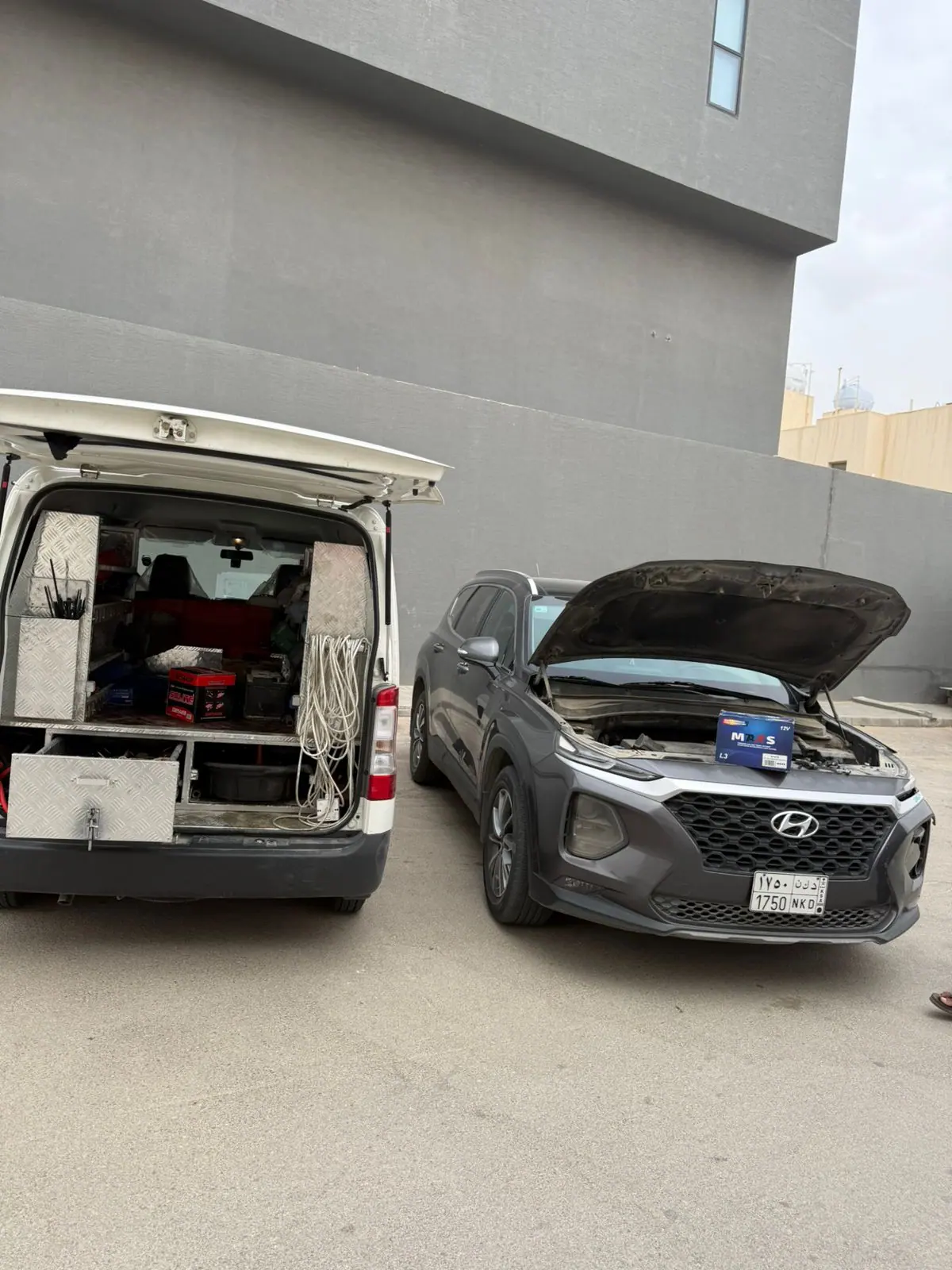
That is what we do. Saaed Service is a mobile workshop in Riyadh — a technician drives to your villa driveway, compound car park, office basement or the hard shoulder, tests the battery and the charging system, and tells you plainly how much life is left. If it is finished we fit the correct type on the spot, register or code it where the car requires that, and take the old one away for recycling. We work 24 hours a day, every day including Fridays, Ramadan nights and Eid, and reach most Riyadh addresses in around 10 minutes. Call or WhatsApp +966 57 970 1115, in Arabic or English. We quote first, and that is what you pay — cash, card or bank transfer.
More guides for Riyadh drivers
Car Overheating in Riyadh Summer
What the temperature gauge is telling you, the first two minutes that save an engine, and when to stop.
Read guide Battery & startingCar Won't Start: A Step-by-Step Checklist
Nothing, one click, cranking but no fire, or starts and dies — what each symptom actually means.
Read guide Tyres & wheelsTyre Pressure and Heat in Riyadh
Set them cold to the door placard, read the DOT date, and know why under-inflation is what causes blowouts.
Read guideQuestions drivers ask
Two to three years is realistic for most cars here. Heat evaporates electrolyte and corrodes the internal plates far faster than a mild climate does, so the same battery that would run four or five years in Europe gives noticeably less in Riyadh. Cars parked outdoors all day, or driven mostly on short trips, sit at the lower end of that range.
Yes, once it passes two years. A hot engine is easy to start, so a battery can lose a large share of its capacity and still crank normally through summer. The load test measures actual cranking amps against the figure stamped on the case, which is the only way to see the loss before a cool morning exposes it in a car park.
The behaviour after a jumpstart gives the first clue. If the engine runs while the leads are connected and dies when they come off, suspect the charging side. If it runs fine afterwards but the car is flat again next morning, suspect the battery or a parasitic drain. Only measurement settles it: alternator output, voltage drop across the cables, and standing current with everything off.
On most European cars with stop-start, yes, and on a growing number of others. The energy-management module tracks battery age and sets charging voltage accordingly, so an unregistered battery gets charged as though it were old and worn. In Riyadh heat that usually means overcharging, boiling water out of a new battery within months. Registration takes minutes with the right diagnostic tool.
Only within limits. You must keep the case size, terminal layout and hold-down that the car was designed for, and the chemistry the car expects — AGM stays AGM. Within those constraints, a higher cold-cranking rating gives more reserve and tolerates heat loss a little longer. Fitting something the tray was never made for causes vibration damage and cable strain instead.
It does. A car standing in open sun all day runs a much higher under-bonnet temperature than one in a basement or shaded car park, and that temperature is the single biggest factor in how fast electrolyte is lost. Shade will not make a battery last forever, but over two summers the difference between covered and uncovered parking is usually months of life.

Rather we just handled it?
Call +966 57 970 1115 and a mobile technician comes to your car anywhere in Riyadh — 24/7, price agreed first.