

What a proper car AC gas refill actually involves
A correct re-gas is four steps and about an hour. A ten-minute top-up from a bottle is a different thing entirely, and it is how compressors get killed.
A proper AC re-gas means recovering the old refrigerant by machine, pulling a deep vacuum to boil out moisture, holding that vacuum with the pump off to prove the system is sealed, then charging by weight to the figure printed on the under-bonnet label. R134a and R1234yf are not interchangeable and must never be mixed. A healthy system should not need gas on any schedule, so if yours does, you have a leak and the leak is the repair.
Air conditioning gas is the most oversold service in Riyadh. Every summer, drivers pay for top-ups that last a few weeks, then pay again, and by the third round the compressor is making noise. The reason is simple: refrigerant is not consumed by use. It sits in a sealed loop and does the same job forever unless it escapes. A car that needs gas is a car with a hole in it, and putting gas into a hole is not a repair.
This guide sets out what a correct re-gas involves, why each step exists, and what goes wrong when steps are skipped. It also covers the two refrigerant types now on Riyadh roads and why mixing them is a serious mistake. None of this is secret knowledge. Understanding it takes ten minutes and it is the difference between paying once and paying every summer.
The four steps, and what each one is for
Step one is recovery. Whatever refrigerant is still in the car is pulled out by machine and weighed. That weight matters: it tells you how much was missing, which tells you how fast the system is leaking. Venting the old gas to the air instead skips the one measurement that turns guesswork into diagnosis. Step two is vacuum. Once the system is empty, a pump drags the pressure down far below atmospheric. Water boils at room temperature under a deep vacuum, so this is how moisture gets removed from the lines rather than sealed inside them.
Step three is the one most often skipped and the most valuable. With the target vacuum reached, the pump is closed off and the system is left alone for ten to fifteen minutes. If the reading holds, the loop is sealed. If it creeps back toward atmospheric, there is a leak and charging it would be throwing gas away. Step four is charging by weight. The under-bonnet label states an exact figure in grams for your car, and a scale is the only way to hit it. Charging by pressure or by how cold the pipe feels produces an overcharge as often as an undercharge.
- Read the under-bonnet label for refrigerant type and exact charge weight in grams
- Recover the existing charge by machine and weigh what came out
- Repair the leak and replace the receiver drier if the system was open to air
- Pull a deep vacuum for long enough to boil moisture out of the lines
- Close the pump and hold the vacuum to prove the system is tight
- Charge by weight on a scale, with the correct PAG oil type and quantity
- Verify both pressures at idle and at raised revs, then measure the centre vent temperature
Why charging by weight, and not by pressure, is the whole point
System pressures move with ambient temperature, humidity, engine speed and airflow across the condenser. On a 48°C afternoon in Riyadh, the same correctly charged car reads very differently than it does at seven in the morning in January. So a technician who charges until the gauge looks right is aiming at a target that keeps moving. Weight does not move. The manufacturer tested the system, worked out the exact mass it needs, and printed it on a label under the bonnet. Match that number and the system is right regardless of the weather.
Overcharging is the specific danger, and it is common because more gas feels like it should mean more cold. It does not. Too much refrigerant fills space in the condenser that should be doing the work of turning gas back into liquid, head pressure climbs, and cooling gets worse rather than better. Worse, liquid refrigerant can reach the compressor, which is built to pump gas and not liquid. That is called slugging, and it damages valves and bearings. An overcharged system in Riyadh heat is genuinely harder on a compressor than a slightly low one.
R134a and R1234yf: two gases, no mixing
Older cars on Riyadh roads run R134a. Newer models use R1234yf, which was introduced to meet environmental rules and behaves similarly but is not the same substance. It costs considerably more, it is classed as mildly flammable, and it needs its own recovery and charging equipment. The service couplings on the two systems are deliberately made different sizes so that the wrong hose will not fit. If you ever see someone using an adapter to get around that, walk away. The fittings differ for a reason.
Mixing the two, or topping an R1234yf car with cheaper R134a, contaminates the charge. The result is a system that does not cool properly, pressures that no longer mean anything, and a car that a proper workshop then has to identify and empty before it can be repaired. It also contaminates the recovery machine, which is why a good technician tests an unknown car with a refrigerant identifier before connecting anything. Check your own label: it states the type and the weight in plain print, and knowing yours before you call saves a wasted visit.
Free top-ups, DIY cans and sealant
A free or very cheap top-up offer works because the offer costs almost nothing to make. There is no recovery, no vacuum, no leak trace and no scale. Gas goes in until a low-side gauge looks acceptable, and the car cools for a few weeks until the same leak empties it again. Each round vents refrigerant to the atmosphere, adds no oil accounting, and buys nothing but time. If the same car comes back three times in a summer, the leak has been paid for three times and never repaired once.
The supermarket cans are worse in one specific way: many of them contain sealant. Sealant is marketed as a fix for small leaks and it works by reacting with moisture and hardening. Inside your AC system that reaction happens where it wants to, including inside the expansion valve, the condenser passages and the compressor. It also sets inside the recovery machine of the next workshop that touches the car, which is why many refuse the job outright once they know sealant has been used. A small O-ring leak is a cheap repair. The same leak after sealant is not.
- Gas added without the old charge being recovered and weighed first
- No vacuum pump used, so any moisture in the system stays in the system
- Charge judged by a single low-side gauge or by feeling the pipes
- No leak test offered, and no explanation of where the gas went
- A can or bottle marked as containing stop-leak or sealant
- An adapter used to fit R134a equipment to an R1234yf service port
Moisture, oil and why the drier matters
Refrigerant does not travel alone. It carries PAG oil around the loop, and that oil is what lubricates the compressor. So a system that has lost half its gas has also lost oil, and the compressor has been running short of lubrication in Riyadh heat for however long it took you to notice. This is the real mechanism behind compressor failure after repeated top-ups. It is not the missing cold that kills the pump, it is the missing oil. When components are replaced, the correct oil type and quantity have to be added back deliberately.
Moisture is the second contaminant. Any leak that lets gas out lets humid air in, and water inside an AC system reacts with PAG oil to form acids that corrode aluminium from the inside. The receiver drier or accumulator contains a desiccant whose job is to absorb small amounts of moisture, and it has a finite capacity. Once a system has been opened to the atmosphere, that desiccant is saturated and the part should be replaced along with the repair. Skipping it is how a properly repaired leak still ends in a corroded evaporator two years later.
How often should a healthy system need gas in Riyadh?
The honest answer is that it should not. No manufacturer lists an AC re-gas in the service schedule beside the oil change and the filters. Hose material does permeate a very small amount over many years, so a car well past eight or ten years old may sit a little low and benefit from being brought back to the label weight once. That is a decade, not a season. Any car needing gas every summer, or twice in one summer, is telling you exactly where the fault is.
What Riyadh does change is how quickly a leak reveals itself. Sustained 48°C days keep head pressure near the top of its range for months, so a marginal O-ring that would seep quietly for years elsewhere empties a system here in one season. Dust accelerates it too, by blocking the condenser and pushing pressures higher still. That is why leak repair here should come before the gas, not after it: fix the seal, then charge to weight, and the system stays where you put it.
If you take one thing from this: ask what happens before the gas goes in. A workshop that recovers, vacuums, holds the vacuum and charges by weight is doing the job. One that hooks up a bottle and watches a single gauge is selling you refrigerant. The difference in time is about an hour. The difference in outcome is a system that still cools next August against one that is warm again by Eid.
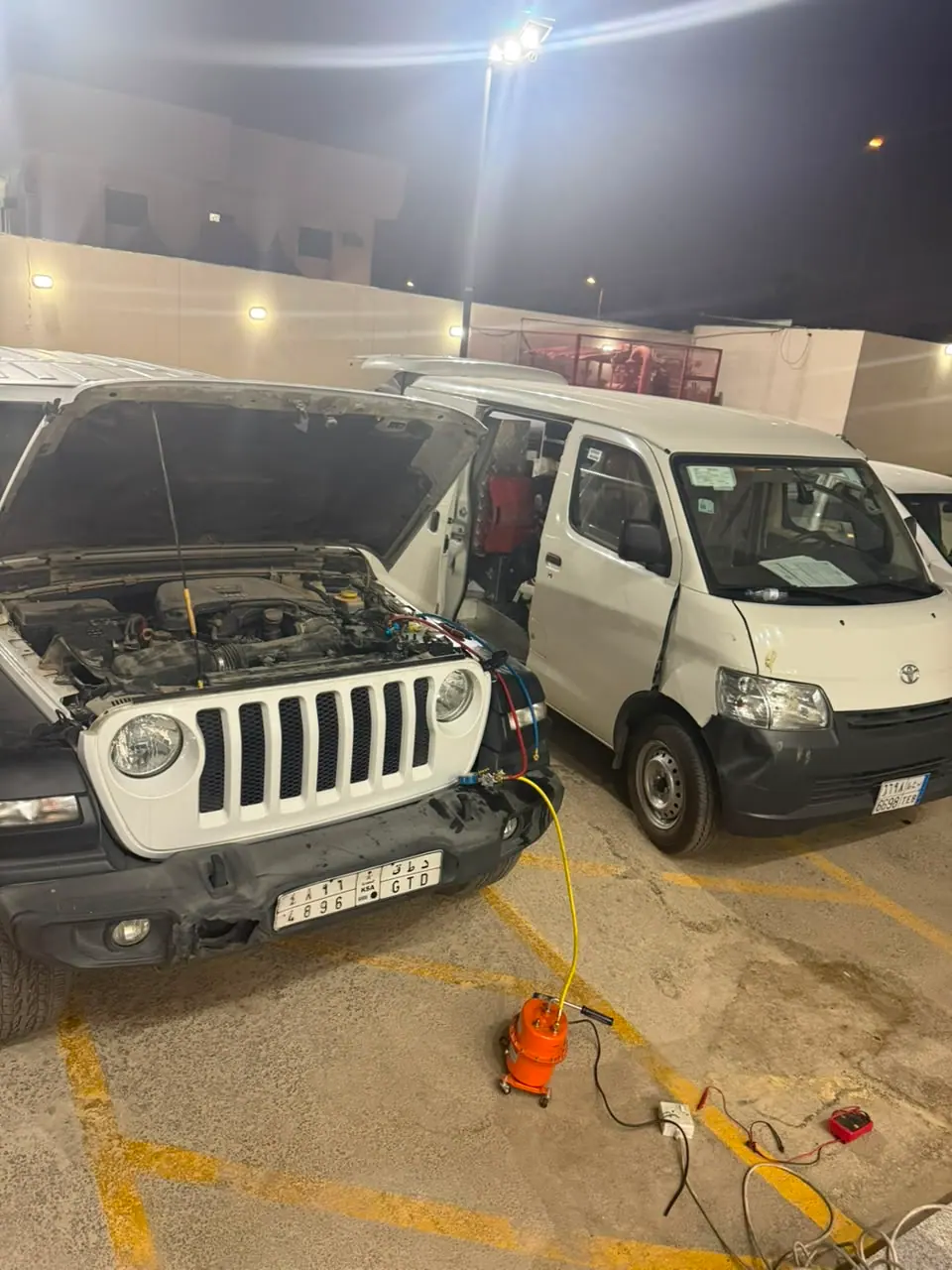
Saaed Service does the full procedure at your car. The recovery and charging machine, vacuum pump, manifold gauges, electronic leak detector and both R134a and R1234yf travel on the van, and the job runs off your own engine, so villa driveways, compound bays and tower basements all work. Our technicians cover Riyadh 24 hours a day including Fridays, Ramadan and Eid, and reach most addresses in around ten minutes. You get the leak test result and one total price before anything is charged, and nothing is added to that figure once we have measured the vent temperature in front of you. Call or WhatsApp 057 970 1115, in Arabic or English.
More guides for Riyadh drivers
Car AC not cooling: the six real causes
Warm air from the vents has six common causes. Here is how to tell them apart from the driver seat.
Read guide Battery & startingCar Battery Life in Riyadh Heat
Why Riyadh heat turns a five-year battery into a two-year battery, and how to catch the end early.
Read guide Cooling & overheatingCar Overheating in Riyadh Summer
What the temperature gauge is telling you, the first two minutes that save an engine, and when to stop.
Read guideQuestions drivers ask
Around an hour for a straightforward job, and most of that hour is the vacuum. Recovery takes a few minutes, the deep vacuum needs a sustained pull to boil moisture out of the lines, and the hold test that proves the system is sealed adds ten to fifteen minutes on its own. Charging by weight and verifying pressures and vent temperature are quick. A ten-minute re-gas has skipped the parts that make it work.
No. They are different substances with different properties and different oil requirements, and the service fittings are deliberately made incompatible so it cannot happen by accident. Mixing them gives you a charge that no longer behaves predictably, pressures that cannot be interpreted, and a system that has to be identified, recovered and emptied before it can be repaired properly. It also contaminates the equipment of the next person who works on the car.
Three common reasons. The gas has already leaked back out, because the leak was never found. The system is overcharged, which raises head pressure and reduces cooling rather than improving it. Or the fault was never refrigerant at all, and a blocked condenser, a dead radiator fan or a stuck blend door is producing the warm air while the charge sits perfectly correct on the gauges.
If the system has been open to the air, yes. The drier holds a desiccant that absorbs moisture, and it has a limited capacity. Once it is saturated, water stays in circulation and combines with PAG oil to form acids that corrode the aluminium components from the inside. It is a small part compared with an evaporator or a compressor, and replacing it during the repair is far cheaper than the failures it prevents.
It is one useful tool of several. Dye circulates with the oil and shows as a bright stain under a UV lamp at the leak point, which is excellent for slow seeps at O-rings and condenser seams. It needs time and running hours to show, so it is not instant. An electronic detector finds leaks faster, and a nitrogen pressure hold works on a system that is already completely empty. Good practice uses whichever suits the case.
Yes. Every piece of equipment involved travels on the van, and the procedure runs off your car's own engine rather than workshop power. We need space to open the bonnet and work at the front of the car, which a villa driveway, a compound parking bay or a basement car park all provide. Basements are usually cooler than the street, which makes measurement and verification more comfortable for everyone.

Rather we just handled it?
Call +966 57 970 1115 and a mobile technician comes to your car anywhere in Riyadh — 24/7, price agreed first.